
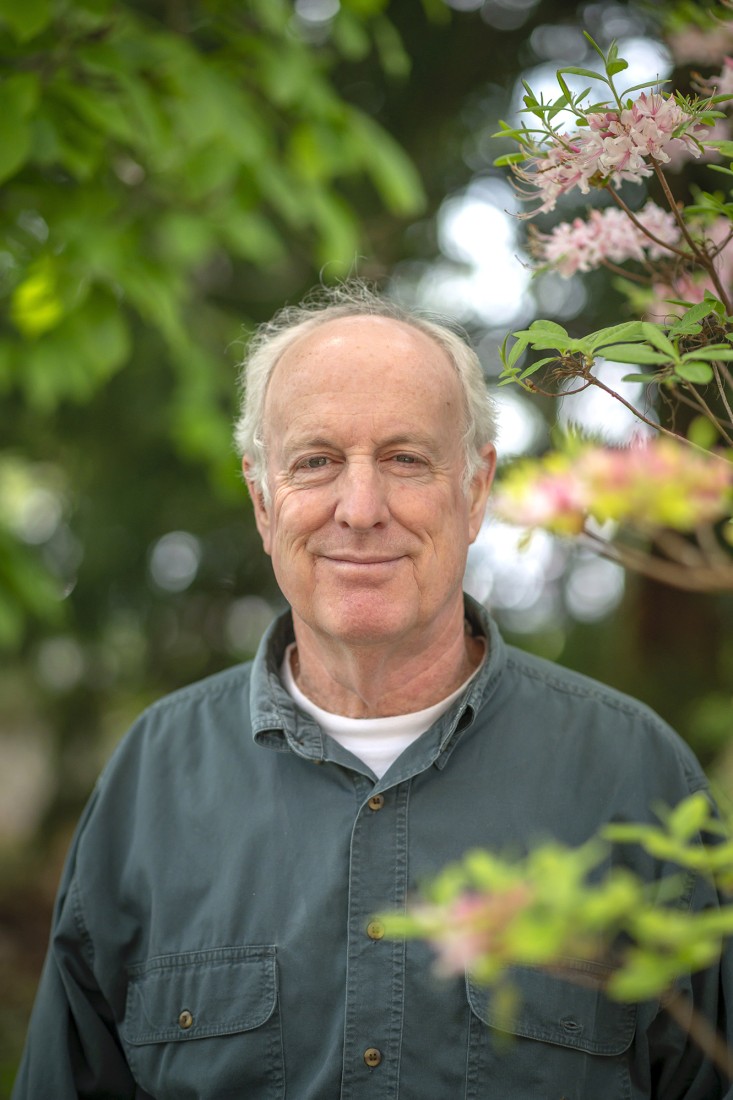
Doug Tallamy is an entomologist and conservationist who promotes biodiversity at a hyperlocal level through landscaping with native plants. He has taught entomology at University of Delaware for 45 years and is the author of five books, including New York Times best-seller Nature’s Best Hope: A New Approach to Conservation that Starts in Your Yard. Doug is a founder of the non-profit Homegrown National Park, which is dedicated to empowering individuals to restore their backyard habitats and replace their lawns with native species in response to the global biodiversity crisis.
I was born in the city of Plainfield, New Jersey, but around third grade, my family moved to Berkeley Heights in the suburbs, and that’s where I spent most of my young years. In Berkeley Heights, our house was built on a circle, and they were building the houses from right to left. The lot to the left of us was undeveloped for a full year after we moved in, and there was a little pond on that lot. I used to go over there every day and see what was happening. And in springtime, toads came and sang, and the females came and they mated with them, and then they laid eggs and the pollywogs hatched. I wanted to be there the day those little guys hopped out onto the shore and started their terrestrial life, but that was the day that the bulldozer buried the whole pond. At the time, I came away with this feeling that we have to save nature before people wreck it. What I could have done was dug a pond in my backyard and moved a lot of those creatures. I know that now, but the idea never occurred to me then.
In grade school, I was interested in the outdoors and not so much in school. It wasn’t until sophomore year of high school that I took biology. In the ’50s and ’60s, there was no ecology in the sciences, it was just dissecting frogs and that kind of thing. I went to Allegheny College, a small liberal arts school in northwestern Pennsylvania, where I studied biology. All of the biology students were pre-med. There weren’t any grad students there, so I didn’t have exposure to research. When I graduated in 1973, I didn’t know what the options were. I didn’t want to be a teacher, because I was too afraid to talk to people. I ended up going to dental school after graduating, and I lasted about two weeks before I found the nerve to end that mistake. I didn’t want to be a dentist!
I needed some advice, so I went back to my college advisors and asked, “What should I do?” They asked what class I had liked the best, and I said entomology, and they told me to go to grad school for that. I lost all my money in dental school, so they advised me to live at home with my parents and pick a school near there. I worked as an orderly in a hospital for six months before I started grad school at Rutgers University, where I earned my master’s degree in entomology.
I was pretty green at the time and didn’t know what I wanted to do in entomology. I would go to this lake in northern New Jersey called Deer Lake, and there were a lot of deer flies there, so I decided to study niche partitioning in deer flies and horseflies. There were 54 species of them there, so the question was how they were all coexisting and dividing up their niches.
It still felt like my future was a big black box; my parents didn’t go to college, so I wasn’t thinking about what could come next. About half way through my master’s, my advisor started saying that I should really go for a PhD. I had gotten married and was ready to start supporting my family, but it felt like the bar kept being raised, so I ended up going on to do a PhD.
I did my PhD at University of Maryland studying eight species of lace bugs, looking at how life history theories predicated what they were doing. Life history questions are things like: How many eggs should you lay? How big should the eggs be? Should you be an R strategist or a K strategist? The answer was that these life history questions didn’t predict much, but it was interesting. I worked with lace bugs because they are reared easily in the lab and because they are host plant specific. I had discovered ecology for the first time at Rutgers, but my PhD was very focused on lab work. I did a post-doc fellowship at University of Iowa and then moved back to the East Coast in 1981 to start teaching at University of Delaware. My focus was really on behavioral entomology, or how and why insects behave the way they do.
In 2000, my wife and I moved, and our new house had 10 acres. That really shifted my direction towards conservation and ecology. In science, you get very compartmentalized; for example, entomologists don’t really learn about or talk about plants. I didn’t know about invasive species. But I started wandering around my yard and trying to identify what was growing there, and I realized it was covered with invasive plants from Asia: autumn olive, multi-flora rose, invasive honeysuckles, Asiatic bittersweet. Then I noticed, “Gee, our native insects are not eating these plants.”
I went to the literature to find out what was happening to native insects with all these invasive plants around, and I couldn’t find anything – nobody was working on it yet. In 2001, I had an undergraduate who wanted to do some research, and I told her she could measure how insects are using native and non-native plants in my yard. I knew about host plant specialization and predicted that the host plant specialists in my yard would not be able to use plants from Asia for growth and reproduction. We were right! Someone at the college wrote something up about it. It got read and people started asking me to give talks. I’ve worked on interesting things over my career – insect parental care, how cucumber beetles choose their mates – but this was the first thing that attracted public attention. I got some grants in 2004, and that’s when we really started to get some data.
I hadn’t published anything about this yet, but people wanted to read about it, so I decided to write a pamphlet, which then turned into my first book. I wrote Bringing Nature Home in 2005, and it was published in 2007. When you write for a scientific audience, every word is scrutinized, but writing for the public, I could be relaxed about it. I was teaching undergrad courses while writing, which was helpful because I could see what they understood or didn’t, and I used that to inform my book.
I came up with the idea and phrase “Homegrown National Park” after I read the statistic about how our country had 40 million acres of lawn. I wondered, “How big is that? What if we cut it in half?” Lawn doesn’t accomplish anything ecologically, so I started to wonder what if just half of it wasn’t lawn but was instead native plants. I started to look up the area of our largest national parks, and they don’t even come close to 20 million acres. I thought, “We can create a new national park at home, and it’ll be bigger than all the parks combined.” We’re in a biodiversity crisis. We’ve lost 3 billion breeding birds in North America in the past 50 years, and there’s been a 22 percent decline in butterflies in the United States just since 2000. I wanted to focus on the idea of what people can do in their own yards to restore food webs. I’ve been counting the number of moths on my property since I started putting it native plants, and it’s up to 1,369 species. I’ve recorded 62 bird species that have bred on our property. All of this because of native plants.
I don’t often get discouraged, because I give a lot of talks and I see hundreds of enthusiastic people. Each one of them is a new conservationist. A lot of them own private property, which covers almost 80 percent of the lower 48 states; they’re the ones that are going to make a difference where they live. Every place I go, people tell me success stories. I have rules, too: no news after dinner, pretend we have a reasonable government. But luckily, for private landowners to make these decisions, the government doesn’t need to be involved.
When I started teaching at University of Delaware, we had around 7 undergrad entomology majors, and now we have 44. Students are interested! I’m 74 now, and I’m retiring next year; this past spring was my last semester teaching. I taught insect taxonomy for 20 years, which is really interesting, and I’ve liked teaching behavioral ecology of insects as well. I won’t miss grading – it’s my 45th year of doing that. It’s necessary and it has to be done, but the older I get, the more big picture I get. It’ll be nice to step back from all the emailing, the committee work, and the day-to-day tasks, but I’ll keep writing and giving talks as long as people are interested.
I’m writing a book right now called Nature’s Resiliency, about how if we stop clobbering nature, it will rebound. I give examples of where that’s happened, and what else is possible. It’s a hopeful message: we can fix it, as long as we start soon. It makes me think of the pond in my childhood – what I could have done was go right across to my backyard and dug another pond. I could have saved a lot of those creatures, but it never occurred to me. I’ve been pushing lately to move beyond conservation into restoration. We can put things back.
Successful conservation comes down to the individual. It comes down to personal responsibility. Everybody requires nature and functioning ecosystems, not just ecologists and conservationists. Everyone is responsible, especially if you “own” a piece of the earth. The most meaningful part of my work is that people are listening and caring about this. They care everywhere, and that’s really heartening. It shows that there’s a chance for all the fantastic diversity of life on this planet. We have the capacity to destroy it all, and there are people who don’t mind doing that – but there are more who do mind, and they’re fighting back.
Discussion *