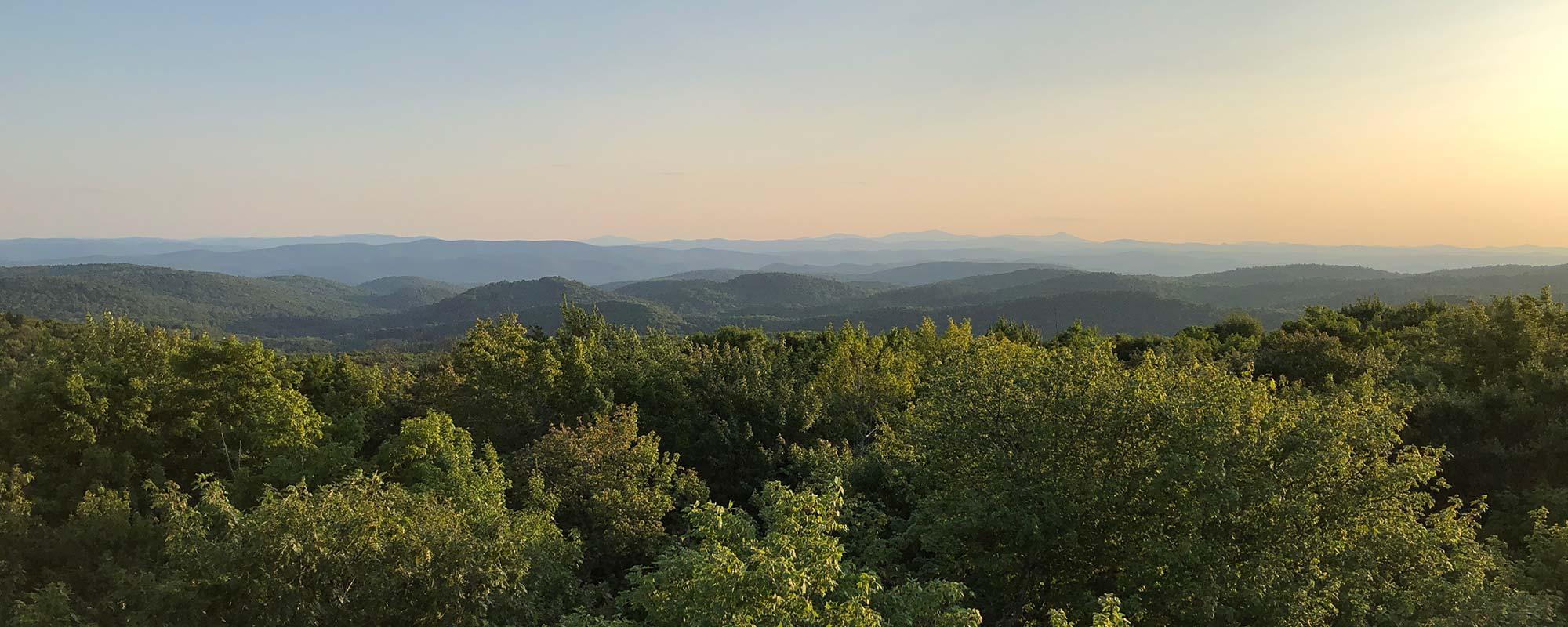

The days of September and October were brilliant, with sunshine descending through a dappled canopy. The tulip poplars turned yellow first. Then the sugar and red maples paraded their flamboyant banners. The sassafras and tupelo crowded the understory with scarlets and oranges, those vibrant hues somehow connected to the taste of the tea we drink and the blossoms bees flock to, honey swirling at the bottom of my cup.
By November, most of the color has fallen out of the trees. The woods turn gunmetal gray, and fog drapes our ridges from peak to valley, forming mist over the carpet of dropped leaves. Still, patches of color linger where the white oaks hang on to their burnished foliage. And in the beech groves, full of leaves like dented copper, the color will remain through winter.
This morning, I entered the woods more than an hour before first light, hiking the ridgeline under a fat, lustrous moon. I planned to sit along the trunk of a cherry tree that had toppled in a way that its crown and root ball prop the trunk 3 feet above the earth and parallel to it, providing just enough girth to hide me and offer a hunter’s view of the hollow.
A few days before, I had cleared fallen leaves and branches in a circle, so while I wait for deer to trail down the ancient crease of a long-dry streambed, my feet will rest on bare dirt rather than crunchy leaves and snapping sticks; I won’t disturb the silence. This is one of my favorite parts of hunting: the quieting of the mind and body. The mainstay of my day shifts from human communication to the language of the forest, which speaks in wind and light, in the movement of birds and animals, and the elusive rhythms of branches as they clack together in the breeze.
Hunting is a ritual as old as humanity. The earth feeds us. But only if we take care how we hunt, how much we take, how we use the life that is given, and how we offer thanks. By the early twentieth century, market hunting and waste had brought the Pennsylvania deer herd to near extirpation. From 1906 to 1925, the Pennsylvania Game Commission undertook a restoration effort, bringing in 1,200 deer from Kentucky, Maine, Michigan, New Jersey, and Ohio and imposing strict hunting regulations. Today, the herd is approximately 1½ million, and many see hunting as an important part of the state’s cultural heritage and a necessary act to keep our forests healthy. Too many deer can decimate a forest as they over-browse, impacting species and age diversity and slowing or negating regeneration of timbered land. With the extirpation of such apex predators as wolves and mountain lions, along with the dwindling population of hunters, the number of deer in Pennsylvania continues to be a source of debate as biologists work with game commission officials to set hunting limits.
Unlike most of my neighbors, who look forward to the social aspects of deer camp, I hunt alone. The way I sleep and think and look at the world changes this time of year. It’s a season given over to deep consideration and concentration. At root is the matter of mortality: when is it right and appropriate to take a life to feed one’s own life? This is different from my forays on streams in spring to catch brook trout. As I fish, I revel in touching the trout, examining its colors and designs, and then releasing it, watching it swim back into the current or beneath hemlock roots that spider the bank.
There is a finality to hunting, if I am fortunate to have success. Beauty – after all, who doesn’t think a white-tailed deer is among the most beautiful and graceful of animals? – is brought crashing to the ground in death. With knowing hands and a sharpened knife, I remake that former life into meat and, like so many, I use an entire nomenclature that distances me from that life, that deer. We say chops and loins and steaks and roasts and burger. Some use the word venison, instead of deer. I remember, when I was around 10, asking my father why we called that part of an animal a chop and this other part a steak. He told me there was a long practice of using the animal and these were the names that told us how to use it. All I knew was that I liked steak best.
When I butcher a deer I have hunted, I remember my Sunday school teacher reading aloud a passage about the fatted calf, about how we come together in communion as we eat. I savor the thought of the future meals a deer will provide after a successful hunt, my friends and neighbors and family sharing in that life, gathering together in thanksgiving and laughter, the story of the hunt being told. Steak snaps and sparks on the grill. A bit of garlic, some salt and crushed red pepper, the meat still red and supple at the center. As I eat, I try hard to recall how the deer’s leg and shoulder moved in concert until its final breath. Something of that animal’s life lives on in us as we eat. When I scramble over a downed log, I recall that I am part deer, too, by the simple fact of the previous night’s meal.
Yet hunting tenders a different kind of sustenance as well. The same Sunday school teacher was fond of saying we do not live by bread alone but by every word that proceeds from the mouth of God. While I’m not sure whose voice – really “voices,” an entire chorus – comes from the mouth of the mountain, I do strain to listen, to learn its ancient wisdom. The very notion of God suggests mystery and a gesture toward what is beyond language. My understanding of whatever we might mean when we say God finds its foundation in the living world, in the infinite connections between all living things, in the fact that we are kin, sharing so much, including large portions of our DNA. In abiding with the mountain and all who live there – watching their ways, trying never to take more than what is offered, and showing gratitude and care – I come to know a little better my station in the ecology and cosmology of that place.
On this day, not long after the stars disappear and the moon shifts to the far horizon, ghost of its body growing ever fainter, as I shelter behind the heft of this fallen cherry tree, I hear steps behind me. Not human. Something lighter that moves with a different rhythm. I don’t want to turn my head in case it’s a deer. But I can tell it’s close, making my heart quicken. I breathe deeply through my nose, try to calm myself. No one ever shot well with shaking hands.
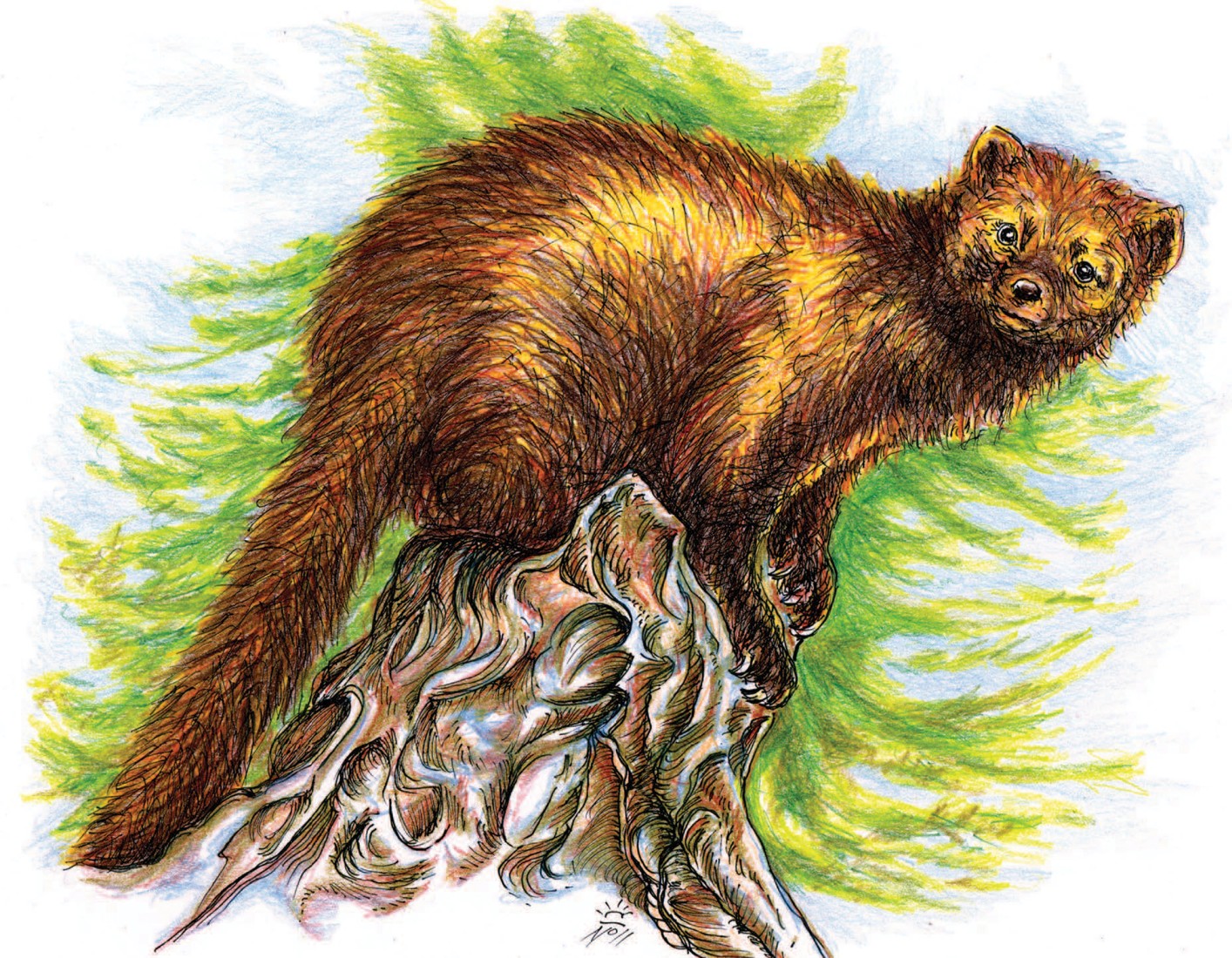
My eyes become slits as I strain to locate the animal by sound, the ruffle of leaves now to my left, exactly parallel to me. I roll my eyes toward the sound and glimpse a bit of fur come to a stop. Not a deer. Not a coyote or bobcat. What has come to rest only 6 feet from me is a mature fisher. I’m surprised by the animal’s size – it’s as large as a fox and looks to weigh around 12 pounds – as well as by its lack of concern with my presence. If I were describing another human, I might call what I perceive in this fisher arrogance.
My mind moves quickly, springing nervously like a snowshoe hare. Why didn’t the fisher pick up my scent? Doesn’t it recognize me for what I am, huddled next to this fallen tree? Might its bold behavior be an aberration caused by some sickness, even rabies?
I’ve seen the remains of porcupines killed by fisher. I’ve followed their tracks in the snow, marveling at the space between their leaping strides. Once, I came upon a fisher on an early September morning hike, just as the fog was burning off. That animal allowed me to follow it for a time, never closer than 50 yards, before it headed up the slope through fox grape vines and the pole timber of striped maple and sweet birch.
This fisher, hunched on all fours, looks at me for a moment, glances up the slope toward a bench that holds some sizeable hemlock and old oak, then looks back at me and stands on its hind legs to peer directly into my eyes.
I am transfixed, with no power to turn my gaze. The face is handsome and what I can only describe as inquisitive, at least in this moment. The fur dark brown, verging on black. The body sleek and glossy and lithely muscled. I can see how speed and quickness inhabit this creature, giving it the ability to dart at its prey, finding the weakest spot to tear and rend and feed itself.
In her essay “Living Like Weasels,” Annie Dillard suggested that she and a weasel exchanged brains during a 60-second look. Unlike Dillard, I do not find myself transported behind those fisher eyes. And, to my knowledge, that fisher does not transmigrate and take residence in my skull.
A transaction, however, takes place, the two of us becoming better acquainted simply by being in the other’s presence. It all lasts less than 30 seconds, although time unravels at a different pace in the presence of wild things. The fisher drops back to all fours and moves leisurely up the hollow, stopping once to look back at me before traveling over the bench, beyond my sight, beyond my hearing, but not beyond my mind.