
Old-growth forests are ecosystems distinguished by old trees and shaped by long periods of natural processes. They differ in important ways from younger forests, offering unique structures, habitats, and functions. There is no single definition for “old growth,” and its features vary by forest type, location, and history. So, what are old-growth forests? Why are they important? And how can we care for them into the future?
What Is “Old Growth”?
Ecologists in the Pacific Northwest began using the term “old growth” during the 1970s to describe forests spared from significant human disturbance after European colonization. These old-growth forests stood in contrast to “second-growth” forests, which had regrown after forests were cleared for farmland or timber, and they contained old trees, multiple canopy layers, trees of many sizes, and abundant decaying wood.
Ecologists describe old growth as a “late successional” stage of forest development that requires decades or even centuries to attain. Reflecting this advanced stage, many definitions now include the absence of catastrophic natural disturbances, such as tornados, avalanches, and hurricanes, which can reset a forest to a younger stage.
Over the past 50 years, variations of the definition for old-growth forests have emerged, reflecting different forest types and perspectives. A key distinction among ecologists lies between those who emphasize the continuity of ecological processes over time compared to those who focus on the presence of observable traits such as tree size, deadwood volume, and multiple canopy layers.
General Characteristics of Old-Growth Forests
Regardless of which aspects ecologists lean toward in defining old growth, what most clearly distinguishes the late successional stage is the presence of very old trees, some approaching their species’ maximum lifespan. While these trees are often large, size alone can be misleading: some large trees are relatively young, while some very old trees remain small. Local conditions including elevation, soils, and climate also influence size.
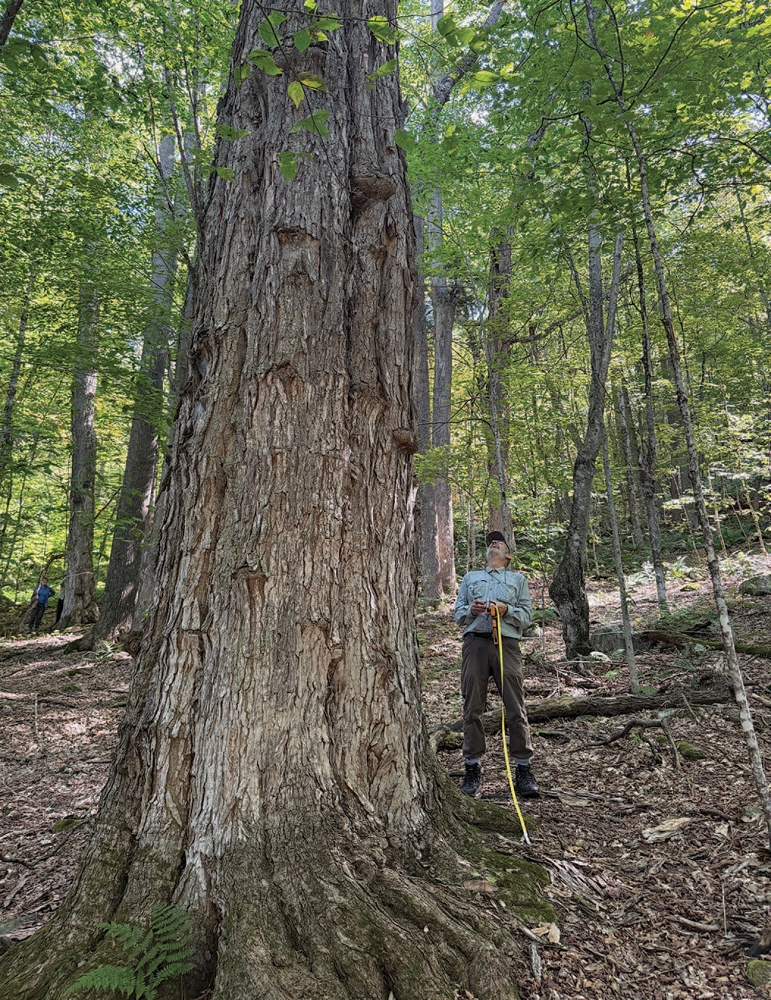
Old trees often show distinctive features that set them apart from younger trees, such as thick bark with deep furrows and unusual branching patterns. Yellow birch and sugar maple, for example, can form “broccoli crowns,” upward-spreading arrays of branches shaped over years of recovery from wind and ice damage. Cavities and decay pockets may be more prevalent in older trees, too.
Small-scale disturbances are essential to the development of old-growth forests. A disease may kill some trees throughout a forest, or a wind gust may topple a single giant. These events open canopy gaps, allowing understory plants and young trees to thrive in sunlight. Over time, the ever-changing pattern of gaps produces multiple canopy layers, a hallmark feature of old growth.
The result is a forest with trees of many ages and sizes, from vigorous saplings to declining elders and standing dead trees (snags). Compared to the more uniform appearance of younger forests, old-growth forests often look complex – even messy. No two spots look the same: one patch may be densely shaded, while a few steps away, sunlight streams through a wide opening in the canopy where a tree recently died.
Deadwood is another defining feature. Old-growth forests contain fallen trunks and piles of interwoven trees and may contain two to four times more deadwood than younger stands – in all stages of decay, from freshly fallen trunks to spongy remnants that sink underfoot.
The forest floor may also bear marks of history. Pit-and-mound topography forms when trees topple and pull up their root masses, leaving depressions beside mounds of soil. Although the presence of this feature does not guarantee old growth, its absence often indicates a forest was once cleared for agriculture.
Challenges in Defining Old Growth
In the Northeast, old growth is often associated with long-lived species such as sugar maple, American beech, yellow birch, red spruce, eastern hemlock, and white pine. Forests dominated by these species can form tall, layered canopies with abundant deadwood. Forests with other species can reflect different characteristics, and there is little consensus among ecologists about which forest types reach the old-growth stage, and if they do, what old growth looks like. High-elevation krummholz forests, for example, can contain old black spruce and balsam fir that remain stunted and shrubby due to harsh winds and winters. Although trees in these forests do not live as long or grow as large as those found at lower elevations, some ecologists recognize krummholz as a distinct old-growth form, adapted to its extreme environment.
Tree age is one of the most debated criteria. Some ecologists define old growth as stands where the average canopy age exceeds half of a species’ maximum lifespan – about 150 years for the iconic northeastern species listed above. But because old growth refers to a developmental stage, it has no precise age threshold. Younger stands may show many traits of old-growth forests, while some older stands do not.
Another uncertainty is extent. A single old tree, no matter how impressive, does not constitute an old-growth forest. Many government agencies set minimum patch sizes in defining old growth – often five acres or more – based on the idea that very small stands may not support the full range of ecological functions that a larger old-growth forest will.
Disturbance history also raises questions, and ecologists debate how much past disturbance a forest can sustain while still being considered old growth. Some human impacts – for instance, Indigenous forest stewardship that has occurred over millennia – have been more harmonious with forest ecology than others. Few forests today are free from such human influence as chestnut blight, invasive plants, air pollution, and climate change. Conversely, decades of fire suppression have altered forests once shaped by frequent burns.
To address these complexities, some ecologists use the term “old forest” for stands in a late successional stage that contain old trees and old growth traits but with a history of human disturbance. “Mature forest” may be used to describe stands that are in the stage immediately preceding late successional forest. With time, mature stands could develop old growth characteristics.
Why Old-Growth Forests Matter
Because most forests in the Northeast were logged or cleared for farms, less than 1 percent of the region’s forests today are considered old growth. The few remnants have often survived in hard-to-reach places: steep ravines, high elevations, or rocky slopes.
Our current forests differ greatly from those where native plants and wildlife co-evolved over millennia, and old-growth forests hold great ecological value. Many species of birds (such as scarlet tanager and wood thrush) and mammals (such as fishers and martens) thrive where old trees and complex canopies are abundant. Certain plants – including Dutchman’s breeches and dwarf ginseng – persist more readily in older forests because of their slow clonal spread or reliance on specialized seed dispersers. Fungi may require decades to form underground networks or depend on large, rotting logs for habitat.
Old trees themselves provide specialized niches. Their rough, fissured bark can support lichens and mosses, such as lungwort and feather flat moss, that do not grow on younger trees. Old trees’ complex crowns provide nesting sites and perches for birds. Hollow openings in their trunks provide dens for flying squirrels, porcupines, and black bears. Even the genetic makeup of old trees may differ from younger trees, as mutations accumulate in their cells over centuries.
Old growth’s deadwood also plays important ecological roles. Woodpeckers excavate snags for insects, creating cavities later used by other animals. Fallen logs shelter salamanders, insects, and fungi; they protect soil, hold moisture during drought, and help move recycled nutrients through the forest as they decay. Many tree seedlings, including hemlock, red spruce, and yellow birch, regenerate best on decomposing nurse logs.
The complex canopy structure of old growth can moderate environmental extremes by slowing rainfall, allowing water to soak gradually into soil, and keeping forest interiors cooler. Although younger forests sequester carbon more quickly due to rapid growth, old-growth forests store far more carbon overall. Their large trees, diversity of tree sizes, deep soils, complexity, and abundant deadwood make old-growth forests vital long-term carbon reservoirs.
The Future of Old Growth
Although only time, and the absence of catastrophic disturbance, can create an old-growth forest, we have opportunities to protect and expand old growth. A holistic approach includes three complementary strategies. First, we can protect existing old-growth forests by safeguarding known stands, locating undocumented ones, and stewarding them against threats from invasive plants, insects, diseases, and climate change.
Second, we can let older forests age by designating them as reserves where natural processes and disturbances gradually develop old growth features. How quickly this happens depends on the site, the forest’s current condition, and future disturbances. Because most northeastern forests are only 60 to 120 years old and largely even-aged, it will take decades to centuries for complex structures and multiple age classes to emerge.
Third, we can accelerate the development of old growth characteristics through active management. This approach allows landowners to increase the “old-growth-ness” of their woods while also meeting goals such as producing wood products, generating income, or enhancing wildlife habitat. Techniques include leaving large “legacy” trees during harvests, felling and leaving trees to increase the amount of downed wood, and varying harvest practices across a property to promote structural complexity. (For more information, see Restoring Old Growth Characteristics to New England’s and New York’s Forests by Anthony D’Amato and Paul Catanzaro.)
Old-growth forests are rare, irreplaceable legacies of natural history. By recognizing their importance and taking deliberate steps to identify, protect, and restore them, we ensure that future generations may experience their vital functions and awe-inspiring beauty.
Discussion *