
Honeybees have been domesticated for millennia, but they don’t always rely on the housing beekeepers provide them in exchange for harvesting their honey. Honeybees remain wild enough to survive on their own, and they can do so miles from the orchards and other food sources with which we associate them. Often, they’ll build their hive in a hollow tree deep in the forest.
Harvesting a “wild” bee tree was the way many local people used to get honey and new colonies of bees. In order to obtain the honey and the bees, the tree often had to be cut down and the honeycomb removed, in the process destroying the hive, so it’s not something that should be done today. Honeybees have enough problems, what with mites and mysterious colony disappearances.
But locating these “bee trees” can still be a challenging and rewarding way to combine woodsmanship, map and compass, GPS, and computer skills into one exercise. Purposely finding a bee tree is possible because worker bees have a habit of returning in a straight line to the hive from a foraging area, hence the term “bee line.” I’ll describe below the equipment needed and the methods that I use in what the oldtimers called “lining bees”, a combination of techniques passed down from my father and my own innovations.
Loaded for Bees
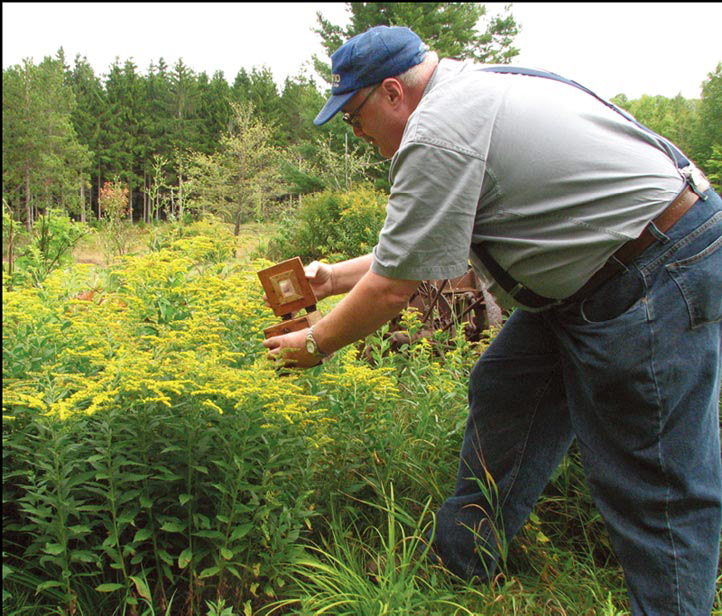
If you’d like to try your hand at finding a wild bee tree, you’ll need the following pieces of equipment: a bee box (see sidebar on page 29 for directions on how to build one); a 2 × 3-inch piece of empty honeycomb (this can be obtained from a beekeeper); some artificial nectar; a stick about 1 inch thick and 5 feet long, sharpened at one end (you can also use a crowbar); a compass; a watch; a brightly colored hat with sun brim; and a pair of binoculars. Optional are a GPS receiver and a computer with a topographical mapping program (I use DeLorme Topo USA and Topo Tools).
While bee hunting, I like to wear a light colored shirt and a blue hat. I want to be highly visible to the bees, as they’ll be using me as a landmark to return to the bee box the first few times. Also, light-colored clothing seems to attract less attention from biting insects, such as deer flies.
Once you have your equipment ready to go, you’ll need to decide when and where to go bee hunting. Although it’s possible to catch and “line” honeybees anytime they’re actively foraging, I like a warm, lightly overcast day at a time of the season when natural food sources are in somewhat short supply. Bees are much easier to see against clouds than they are against a blue sky, and if the bee’s favorite natural foods are plentiful, they can be reluctant to work your box.
The honeybee’s favorite foods in my area include white clover, goldenrod, and milkweed. I have had my best luck lining bees in late August and early September, when about the only food available is goldenrod and the bees are feeding heavily in preparation for winter. Be aware that although you’re looking for a wild swarm, bees from a domestic hive look and act exactly the same way as their feral counterparts. It’s a good idea to know where people are keeping hives so you don’t spend hours bee hunting, only to find yourself in someone’s back yard at their bee hive.
Just before you go out, mix up a batch of artificial nectar. I use plain granulated sugar and water with a touch of honey. Use about 1 teaspoon of honey for every 2 tablespoons of sugar. Add enough water to completely dissolve the sugar and honey. The mixture should be clear, not thick like syrup, but closer to water. You may need to play with these proportions, as bees can be finicky about what they’ll feed on. Make about ¼ cup of this mixture. Put your piece of honeycomb in the bottom of the box and spoon the sugar water into it until the cells are full. Try not to spill sticky sugar water all over the inside of the box. If a bee gets into it, she’ll have a hard time flying and won’t be interested in returning to your box. Any leftover sugar water can be put into a small waterproof bottle to carry in your pocket, whichyou can use to replenish the comb as needed. Make sure that the artificial nectar mix is absolutely pure, with no contaminants such as insect repellent or gasoline.
Find a field where honeybees are foraging and seek out an open spot with low vegetation, as close to the foraging honeybees as possible, where you can sit on the ground and see the sky in all directions. Firmly drive the pointed end of your stick into the ground here.
To Catch a Bee
You now need to catch a honeybee in your box without hurting her. Keep the center partition closed tight, with the honeycomb full of sugar water in the bottom compartment. Carefully approach a honeybee, and in a smooth, fluid upward movement, sweep the bee off the flower into the box and snap the cover shut – without catching the bee between cover and box. This will take some practice.
When you’re successful, you’ll have a honeybee trapped in the top of your box. You’ll be able to see her trying to get out through the window. Slide open the center partition, making sure not to let the partition (and bee) come all the way out of the box. The goal now is to get the bee into the bottom compartment with the honeycomb and to keep her there long enough that she will start feeding on the sugar water. She will head for any light, so you can cover the window with your hand and wait, hoping the bee will find the comb, or you can shake the bee into the bottom compartment. I do this by holding one hand over the top of the box to cover the window, and using the other to hold the box and the slide open, raise the box high, then accelerate it downward, stopping abruptly. Here’s another time to be careful not to shake sugar water all over the inside of the bottom compartment.
Immediately close the partition all the way and look into the window to see if the bee has dropped to the bottom compartment. If she hasn’t, open the partition and try again. If she has, move over to your stick and gently hang the box on it. Listen to the bee. Within a couple of minutes, she should settle down and feed. Sometimes a bee will refuse to feed, in which case, let her go and catch another. If no bees will feed, there may be a problem with the sugar water mix.
Once the bee has stopped buzzing, open the top cover, then very carefully slide open the partition and leave it hanging just into the box. If the bee doesn’t immediately fly out, sit down on the ground a few feet away, where you can watch the box. If you’re lucky, the bee will emerge after one or two minutes, fly all around the box (and maybe you) for a few seconds, making ever widening circles around the box and you before suddenly heading off in one direction. You must try to keep your eyes on the bee. The direction she takes will point you toward her colony.
The Wait
When the bee leaves the box, mark the time. Remain seated where you are and wait; if she returns, she’ll use you as a visible reference to help find the box. Upon her return, the bee will zoom around you several times, then fly rapidly in a zigzag fashion all around, over, under, and in and out of the box, before going back inside to feed. Mark the time the bee returns. You now have a rough idea how far away the hive is.
The bee will probably keep repeating this feeding routine as long as the box is there with food. Each time she leaves, you’ll get a more definite direction, or “line.” After a few trips, she will do little or no circling when she leaves, she’ll just head straight for the hive. On one of her trips home the bee may call other workers from the hive to help with the new food supply. Continue to watch the bee(s) coming and going until you’re confident of the exact line she takes, and the round-trip time; then take a compass bearing on the line. If it takes under 3 minutes for the bee to make the round trip to the hive, the bee tree is close, probably under a quarter-mile; if 5 to 10 minutes, up to a half-mile; if 10 to 20 minutes, up to a mile. Bees rarely travel more than a mile in search of food. The travel time will vary depending on weather, temperature, and the distance within the tree the bee has to walk to get to the comb. It will also take longer if the bee tries to recruit other bees to exploit the new bonanza.
“Lining”
At this point, if it seems that the tree is close, say 5 minutes round trip or less, you can simply start walking on the “line,” using your compass to keep a steady heading. Check all possible trees within sight of the line as you go. You’re looking for holes in trees and bees flying in the same direction past openings in the canopy. Investigate any tree holes and cavities. The colony will probably be in a cavity in a large or damaged tree, so pay close attention to these. This takes a lot of patience, and it isn’t easy to spot bees coming and going from a hole 50 feet up in a tree. It might also be 2 feet from the ground. Keep your ears open, too. Sometimes it’s possible to hear the bees buzzing, especially if it’s a big swarm.
If the bee takes more than 10 minutes to make the round trip, it will be very difficult to find the colony by walking from the original capture site. Since you know the direction in which the tree lies, try to catch another bee closer to the tree. If you’re successful, you’ll be able to triangulate the two bee lines to find the general area of the tree. I mark into my GPS receiver the two (or more) locations where I catch bees, then transfer these coordinates to a mapping program on my computer. Using this program and the bearings I took, I draw lines and look for the hive at their intersection.
Another method that may help is moving the bee closer to the tree. Once the bee (or bees) is feeding regularly at the box, you can move the box to another open area that is directly on the bee line, such as a road, power-line right of way, or field. The more visible you are to the bee, the better. At the new location, open the slider and let the bee feed, and, as before, observe the bee line. If you inadvertently go beyond the bee tree, or stray too far off the line, the bee will be unable to find the box, and won’t return. If the bee does return, the trip time should be shorter, and the margin of error smaller. If I move the box toward the hive, and if I have several bees working, I like to set up a dish of sugar water at the original site to keep the remaining bees coming, in case moving the box doesn’t work. Just put a piece of sponge in sugar water in a small bowl, and set it up in the exact spot where the box was at the beginning.
If you find the tree you’re searching for, mark the location in your GPS and put it on your computer map. That way, you’ll be able to return easily in future years to see if the bees are still there. If the hive entrance is low enough, you can also take some pictures or video.
Setting out to find a bee tree, and succeeding, is a feat few people get to accomplish these days. It’s good exercise, and you’ll learn something about honeybees and the plant and insect communities in the fields that they frequent. Mostly it’s a lot of fun and one more excuse to get out into the woods.


Discussion *