
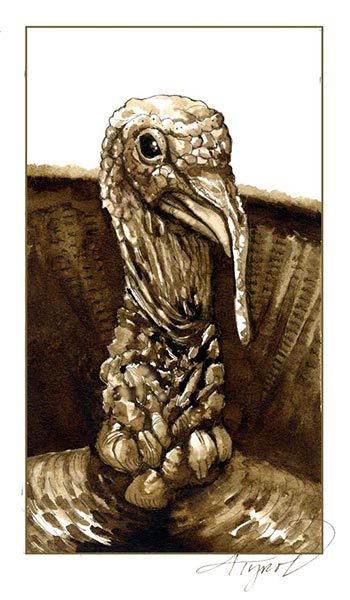
By late October, with the summer birds long gone, I find myself growing ever more appreciative of the birds that stick around, including wild turkeys. With their leathery necks and odd gaits, they are reliably entertaining and interesting subjects.
There are six subspecies of wild turkeys found in North America, with the eastern subspecies, Meleagris gallopavo silvestris, being the most prolific. In Vermont there are an estimated 40,000 to 60,000 birds, while in New Hampshire the figure is about 40,000.
Despite their numbers and year-round presence, they aren’t always easy to see. The onset of fall brings about behavioral changes in the birds and, sadly for those of us who enjoy watching them, that can mean fewer sightings than in spring and summer.
As the days grow short and cold and hard frosts become widespread, the grasses where turkeys forage for insects and seeds die off. The need for an alternative food source arises and this is when the hunt for nuts begins. According to Amy Alfieri, Wild Turkey Project Leader for the Vermont Fish and Wildlife Department, we tend to see less and less of them as the search for mast pulls the birds from the roadsides and fields and into the forests.
The transition from field to forest also makes for different hunting tactics and challenges. In spring, hunters only pursue male turkeys (toms), which are often out in the open, strutting their stuff. “In the spring, the toms like to be seen,” explained Gary Spooner, who teaches hunter safety for the Upper Valley Fish and Game Club. In autumn, hunters can shoot birds of either sex, but good nut years tend to disperse the birds, which can make them harder to locate. Also in fall, mature toms are much warier. “Once a tom has been around a season or two,” said Spooner, “they know how to get away.”
Not only do turkeys’ feeding grounds change as summer fades, so does the company they keep. In the spring and summer, hens and their poults stick together day and night, with flocks often consisting of several hens and their offspring. Once fall sets in, however, the poults are often no longer roosting in the same trees as their mothers. They find nearby trees in which to spend the night. During the day, the poults and hens still feed and travel together.
The more significant shift, however, is the departure of the young males, known as jakes, from an established flock. The jakes leave their mothers and sisters and form their own flocks, with siblings often sticking together and joining other young males. Mature toms will also flock with one another in the winter and then separate when the breeding season starts in the spring.
But first they need to make it through winter. As autumn mast becomes more scarce, turkeys survive on mosses, buds, seeds, and fern spores. They will also scavenge man-made food supplies, and these may lure them out into the open at times you would not otherwise see them: for example, feasting on scattered corn left after the harvest, or seeds beneath a birdfeeder. Manure piles are also popular winter feeding sites.
Though last winter was an especially cold one, a status report put out by the New Hampshire Fish and Game Department noted that the cold had relatively little impact on the wild turkey population. In Vermont, the 2014 spring harvest was lower than the previous year, which may indicate a slight dip in population, but not dramatic, said Alfieri.
Turkeys can generally manage the bitter cold. They have a harder time in deep powdery snow, which makes foraging for food and escaping predators a challenge. According to Alfieri, they can scratch through a maximum six inches of fluffy snow, and about a foot of packed snow. When the ground gets covered with a powdery snowfall, flocks will congregate in stands of hemlock, pine, and other softwoods. "Softwood stands provide mostly shelter, as the trees will hold snow in the canopy, and there will be less on the ground for the turkeys to contend with," explains Alfieri.
As the days continue to get shorter and the temperatures continue to drop, we may have to work a little harder to catch a glimpse of wild turkeys. But they are out there – flocks of hens and poults, jakes and toms – preparing to tough out another winter.
Discussion *