
Skip to navigation Skip to content

Maul vs. Axe

July_06055.jpg
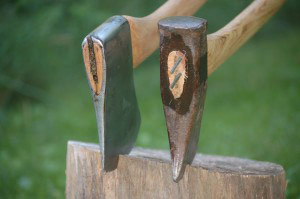
The axe head (left) is skinny, sharp, and light for chopping. The maul head (right) is fat, blunt, and heavy for splitting.

If you want to identify yourself as someone who knows nothing about the subject, announce that you’re headed out to the woodshed to chop some firewood.

Chopping firewood went out of style with the crosscut saw and was sent into permanent exile by the chainsaw. As a method for obtaining firewood, chopping wood is terribly inefficient – nearly half the wood is turned into chips and left in the woods to rot.

Splitting wood, however – now there’s the thing. Splitting is a marvelous technique for turning bolts of tree trunk into chunks of firewood with almost no waste at all. If the wood happens to be straight, knot-free white ash, there’s almost no effort, either.

This distinction between chopping and splitting is more than just, well, chopping hairs. The two are different techniques requiring different tools. Use the wrong tool for the job, and you will wind up either in the emergency room or in a rage of frustration.

First the tools. Though it’s tempting to call any chunk of axe-like metal attached to a handle an “axe,” the true axe has two defining characteristics: it’s sharp and it’s thin.

The axe is designed to cut its way across wood fibers. In a single swing of the axe, the sharp bit slices into the wood, followed by the thin blade slipping in to cut deeply across the fibers, followed by the eye of the axe head – the fat part surrounding the handle – separating the wood and popping out the resulting wood chip.

This is what chopping wood means: cutting, not splitting. You approach your trunk or tree branch and whack away across the grain, knocking out chips as you go, digging an ever-deeper “V” into the wood until you reach the far side.

Now to the splitting maul, sometimes just called a maul, and occasionally called a “splitting axe” by old-timers. The maul has the opposite characteristics of the axe: it’s blunt and fat. The maul is designed to divide a piece of wood in two by forcing the wood fibers apart parallel to the grain. The dull edge exploits a crack between fibers, and the V-shaped head forces the crack apart with continuous pressure.

What if you attempt to split a piece of firewood with an axe? If you’re lucky, the thin blade will sink deeply into the wood and stick there so tightly that you’ll ponder throwing the whole works – axe and all – into the woodstove to burn it out. If you’re unlucky, the force of the axe will split the wood all the way through, burying your sharp axe in the dirt and curling deep gouges out of the blade that will take hours to repair with a file and stone. Suddenly the maul’s bluntness starts to make sense.

Worse yet is trying to chop wood with a maul. The maul’s blunt blade will glance off the limb or trunk, typically careening in the direction of your leg.

Besides these learning-by-doing methods, which aren’t recommended, there are two more ways to tell an axe from a maul, even if the tool in question is a rusty item of unknown origin leaning in the deep shadows of the tool shed. Mauls are heavy – usually six to eight pounds – while axes are light, typically three to four pounds. The entire swing of the maul occurs in the center plane of the swinger’s body, where the strong muscles guide and contain the heavy weight. An axe, on the other hand, can be used anywhere from eye level for limbing a tree to ankle level if the tree is already down. Even a beefy lumberjack would have trouble swinging an 8-pound axe all day, given the wide array of arm angles and muscles involved.

Finally, there’s handle length. A maul handle is relatively long so as to guide the maul into the ground after it finishes splitting the wood, not back in the direction of your feet. An axe handle is short so that when you lean over to limb a tree lying on the ground, the axe swings above the ground, not into it. Use your arm length as an approximate guide: if the handle is longer, it’s a maul, if it’s the same or shorter, it’s an axe.

There’s no better time, with the soaring cost of home heating oil, to take matters into your own hands and learn to split your own firewood. Just don’t announce that you’re going to chop it. Besides being wasteful and potentially dangerous, “chopping firewood” lands hard on the ears, much like the sound of a nice, sharp axe slicing through a piece of firewood and into a rock buried underneath.

Discussion *

Jan 14, 2021

Read all with joy. And was a good read. As I was young back in the 50’s, I knew everthing lol.

Just to teach me that muscle is different from knowledge my dad would give me a tip in the art of spitting wood every time I thought I knew it all.

1) Use a dull axe or maul, your bit will not become stuck as often , your not splitting fibres and the blade will not become sticky from sap or resin.
2) As mentioned before that slight twist as the tool strikes the wood.
3) Place the wood upside down , that way you are splitting with the wood grain instead of against, back to #2, you are not splitting fibres.
4) By placing it upside down you are splitting with the curvature of the knots, splitting vs chopping against the grains.
5) Use a good splitting block that is cut to you heights, it allows you to use your arms, shoulders ,back an hips to your advantages,  you loose force it to low or to high, and it allow you to maintain balance.
5) Always use a spitting block the ground is like sponge and absorbs the shock wave/energy.
6) If you can not advoid a knot, split just to the side so the curvature of the wood will peel around the knot.
7 ) ’ IF’ the axe becomes wedged in the block and you decide to lift it above your head and bring it down on the butt of the axe, try to bring it down straight, vs a swinging motion, more control, and less chance of it breaking handle or the handle kicking upward hurting your wrist an loosing control.

Many more but it’s a start!

Ed Hansen
Jan 14, 2021

(Responding to Brian Hagey) I understand your question, it is an understanding of iron. A nice Swedish built axe from quality steel and not overly thick and heavy will have a ringing noise when you tap it or snit it with your finger nail.

A heavy axe or maul or one that has a less quality of steel vs iron will not have a ring to it. So the old joke of going to the store to buy a nice axe that has a ring to it.

Ed Hansen
Jan 02, 2021

Great article and even better comments - my thanks to all.

Just started splitting my own firewood. Initially chainsaw’d 14-16” Length / up to 8-10” dia. logs of downed tree branches (and some smaller trees) from around the house and was splitting up the Logs with a hatchet. Yup. Pretty funny watching me try to slice up a twisted, knotty holly tree log… but by goodness, I did it. My wrists didn’t appreciate it.
Anyway - I just bought an 8 lb splitting maul… and giggle every time i slips these logs weather pine, oak or maple (and also those gnarly holly tree logs - which burn faster like birch) .

Been great reading everyone’s wisdom - hope that sharing my beginner (at age 52) experience would either be a good laugh for most, or provide a beginner an ‘ah-ha’ moment. Either way, cheers and good splitting!

Tim
Apr 29, 2019

Been reading quite a few of the comments above and I’m amazed by how many people actually prefer using a regular axe as opposed to a maul axe for splitting wood.  But, as one poster wrote, it all depends on what suits you best as regards what type of axe you use.
Here in South Africa we don’t have those long cold winters as in Europe or North America, so many people - even in remote farming areas - are happy to heat their homes using gas or electricity. However, due to the spiralling cost of electricity here, more and more homeowners are installing wood burners in their homes.  Living in an urban area, I don’t have access to trees growing in my immediate vicinity, so whenever I hear the sound of a chainsaw, or see tree fellers in action, I will ask the person for wood which I then would load up and then when I get home, cut logs to size using my Stihl M390.  These logs would then weather for a year, then they would meet my 3kg maul axe.  At first I used an ordinary 1.5kg axe, but it was tough going, and it became a real chore to get anywhere, but then I discovered a maul axe, and , for me it was just great - made all the difference !  We have lots of Australian Bluegum here, which is great fire wood, but the best of all are some African hardwoods - mahogany is the best, and it burns forever with a great heat, but it’s really, really hard to split.  Ok, I’m 77, so maybe it would have been easier for me a few years ago. Who knows…
Good luck, All.

John Tringham
Sep 06, 2018

Dad welded an 8lb maul head to a thick metal pole. Sharpened it too, not too thin. That thing is the best wood splitter you’d ever see. Just got done with 2 cords of knotty oak.  Didn’t stand a chance.  Tired as hell though.

My 2cents.

Have fun split’n!

Larry
Mar 26, 2018

My dad always used an axe to split wood, he could get stuff to really fly.

I tried a maul in Canada and hated the thing, was quite tempted to sharpen it,  though that was vetoed. Went back to using an axe…just more intuitive for me and got along a lot better with it.

John
Oct 15, 2017

It all depends on the wood. If I saw someone trying to split with an axe I’d gladly pick up a beer and sit back and laugh. Our spongy black pine will bounce an axe like a thick piece of rubber. Maul is the only way to go here in the PNW.

Ty
Sep 05, 2017

From mild experience, about a decade, landscaping or logging firewood in winter. Chopping/chipping across grain, lowering stump, removing roots… I always used a sharp low weight axe. Splitting firewood using a maul. This being said, there’re many different variables that will make ummm… 1 man = 2 cords/day or I should have stayed in bed today. Questions: 1 what species of wood? 2 time of year?(temp and season) 3 how fat are the trunks? 4 how far transport? 5 is the wood seasoned? and my favorite… knots/bench cuts? Sometimes you may get angry at said pieces/round of wood. Fear not… that round of wood, that may contribute to a whopping 4 pieces of firewood, may not know it yet but it’s going to split. Sure I could chainsaw it a little more but where is the release of anger that I enjoy? Like driving golfballs, have you ever found yourself talking to the ball you’re about to hit? I’m just kindy reminding the jagged/slowly becoming toothpicks round what’s going to happen. The talking part is a joke until 80 or so cords. Other plusses: after splitting for a month you will definitely be stronger. Also, like in boxing, don’t punch your object right in their face… punch then to the back of their head. Continue through the firewood. Who cares if you hit your maul tip off some rocks? (Wear safety goggles)

Drew
Jun 29, 2017

I believe some people cannot tell the difference between a splitting maul and a splitting axe. I too was confused when I first saw this tool. A splitting maul is essentially a type of an axe that cuts logs along the grain (the inside of the tree). An axe such as felling axe or camp axe cuts logs against the grain (cutting into the bark).

Angela
Apr 24, 2017

I’ve got to say, good reading.  I just bought a Truper brand 6lb. maul because I got a new saw for Christmas and probably dropped a few more Ash trees than I feel like processing.  We had the Asian Ash Borer Beatle blight here. 

Anyway, out of necessity, I’ve found that the straight grains, Ash, and especially wild cherry, will make you look like an Old Testament god with nothing but a light single/double sided ax. The maul is invaluable, but if things are frozen, or the wood is right, with a little practice you can almost plank the pieces as you go. 

It’s been ages since we had chestnut here in any number, but I’ve uncovered one rotting into the ground and a few inches in is beautiful wood.  That and walnut, I’d love to have more.  But if you hunt these along with barn wood for craftsmanship, the log rotting on the ground may just be what you are looking for.  Find somebody with a mill and a planer and you’ve got it.

Ethan

Leave a reply

To ensure a respectful dialogue, please refrain from posting content that is unlawful, harassing, discriminatory, libelous, obscene, or inflammatory. Northern Woodlands assumes no responsibility or liability arising from forum postings and reserves the right to edit all postings. Thanks for joining the discussion.