
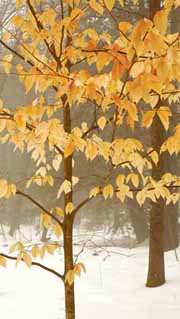
Those dead, bleached-brown beech and oak leaves rattling in a January wind – but somehow still clinging to their twigs – are symbolic. Like ecological pennants, they announce that beech and oak are not quite finished; that these species are still works in progress.
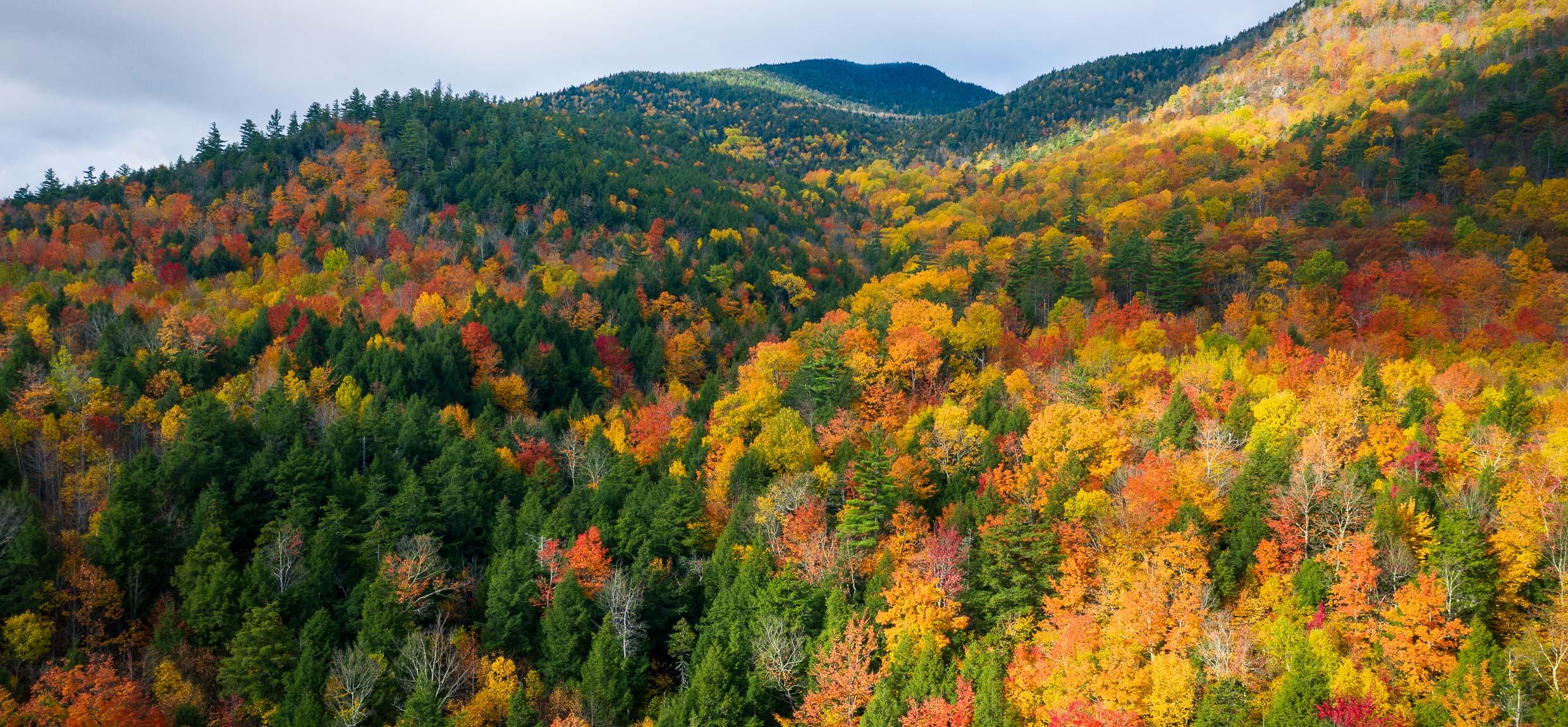
To understand this, consider both the physiology and the evolutionary history of trees. All living trees shed their leaves at some time. Every leaf has a finite life span; each will fade and fall at some regular interval. But there is great variation in the timing of this leaf fall. At one end of the spectrum, there are evergreens. Though they appear to be fully leafed at all times, evergreen leaves are not always green, and entire age classes of needles die, turn brown, and fall every year. On the other end of the spectrum are deciduous trees, which seem to drop their leaves all at once after a pigment party every fall.
For a very long time, evergreen was the only way to be. Literally. Evergreens were the first trees on the planet. Populations of those earliest evergreen trees encountered changing growing conditions as they expanded their ranges and as the long march of time proceeded. As if to hedge their bets against future change, trees began to develop different ways of doing what trees do, including new ways of growing and shedding their leaves. Thus our colorfully famous, broad-leafed hardwood was born.
Today in our woods, we still have several evergreens, like pine, spruce, hemlock, and fir. And we’ve also got the relative newcomers with short-lived leaves – birch, maple, cherry, and aspen, for example. But then we have a third class of tree in beech and oak that seems to represent a middle ground of sorts between evergreen and deciduous. Their leaves die, but many don’t fall when they die. Botanists call this retention of dead plant matter marcescence.
Evergreen-ness is thought to confer an advantage to a tree by increasing the time available for its leaves to remain photosynthetic and by reducing nutrient losses associated with dropped leaves. Deciduous leaf fall, on the other hand, is considered an adaptation that evolved to allow trees in seasonally changing environments to reduce water loss and frost damage during unfavorable seasons while increasing their photosynthetic efficiency during favorable seasons. These are two strikingly different approaches. Each has its advantages and downsides, and over millennia, most species seem to have settled in to being one or the other.
The question remains then as to whether there is any ecological advantage to being somewhere in between. While physiologists agree that marcescence is a juvenile trait, most commonly observed on young trees and on lower branches, there is considerable debate about why some species would seem to be deciduous in all other respects except that they delay the physiological process of leaf shedding.
Some ecologists suggest that marcescence has adaptive significance for trees growing on dry, infertile sites. Sure enough, that’s often where we see beech and oak growing well and outcompeting other species. The thinking is that retaining leaves until spring could be a means of slowing the decomposition of the leaves (they would rot faster if on the ground) and that dropping them in spring delivers organic material (think compost or mulch) at a time when it is most needed by the growing parent tree. Even small amounts at the right time could shift the competitive advantage toward these species on poor sites.
Others suggest that retained leaves, particularly on young trees and the lower branches on bigger trees, is an effective means of trapping snow like a fence, leading to more moisture at the base of the trees come spring. Still others have hypothesized that persistent leaves might provide some frost protection for buds and new twigs over winter. And at least one study suggested that marcescent foliage could be a deterrent to browsing by deer and moose. Buds hidden by clusters of dead leaves do not get eaten and thus live to become new shoots and leaves in spring.
We do not know whether marcescence provides a competitive benefit to beech and oak, but we do know that these two species are closely related; they are in the same family (beech). In fact, the beech family includes many, get this, evergreen species (live oaks and tanoaks, for example, which do not grow in our region). Marcescence may indeed be helpful to trees living in dry, cold, deer-infested environments. But it may also be simply a sign that beech and oak are evolutionarily delayed, still on their way to becoming fully deciduous from their more evergreen past.
Discussion *