Skip to navigation Skip to content

Harvesting Timber in the Adirondacks

A student in the Paul Smith’s College forestry program uses a log loader to sort materials on the landing for…
A student in the Paul Smith’s College forestry program uses a log loader to sort materials on the landing for different uses and products. Photos by Erika Bailey. Select this image or scroll down to view the photo gallery.

In March 2021, upstate New York-based photographer Erika Bailey joined members of Paul Smith’s College Timber Harvesting Crew for a day to document their harvesting activities in a stand in the northern Adirondacks. Weeks prior, a sophomore silviculture class marked the stand for harvest under the supervision of College Forester John Foppert, putting into practice lessons in ecology, wood properties, economics, and plant physiology. For this site, top forestry operations students are implementing a prescription for a free thinning, intended to improve the health of the remaining trees in the stand and favor the best trees for future growth rather than maximize income from the immediate harvest.

This Web Extra accompanies “Lessons Gleaned from the Forest” by Brett McLeod and Erika Bailey in the Winter 2021 issue of Northern Woodlands.

Dana Tripp, a member of the Paul Smith’s Timber Harvesting Crew, brings a load of logs to a roadside landing.
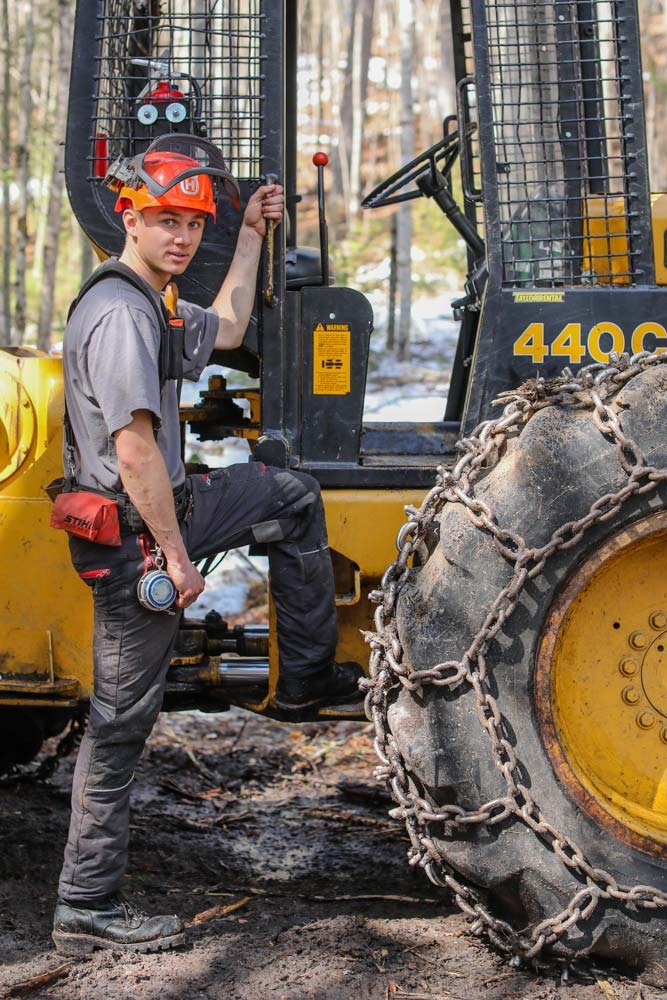
Tim Sawitsky (left) and Dana Tripp (right) are both seniors in the forestry program at Paul Smith’s College. Upon…
Tim Sawitsky (left) and Dana Tripp (right) are both seniors in the forestry program at Paul Smith’s College. Upon graduation Tim will join Prentice & Carlisle as a forester in Maine; Dana is pursuing an MBA in hopes of starting his own tree care and forest management company.
Tim Sawitsky uses a smaller cable skidder to access trees in locations that the larger grapple skidder can’t reach.
The direction of the notch dictates where the tree will fall. Note that the upcut and downcut of the notch meet…
The direction of the notch dictates where the tree will fall. Note that the upcut and downcut of the notch meet perfectly so that the hinge wood isn’t compromised.
The bore cut sets the thinness of the hinge but retains a trigger or backstrap of uncut wood until it’s time to let…
The bore cut sets the thinness of the hinge but retains a trigger or backstrap of uncut wood until it’s time to let the tree fall.
Plastic felling wedges are pounded into the saw kerf to overcome lean and create lift.
Cutting the trigger to fell the tree.
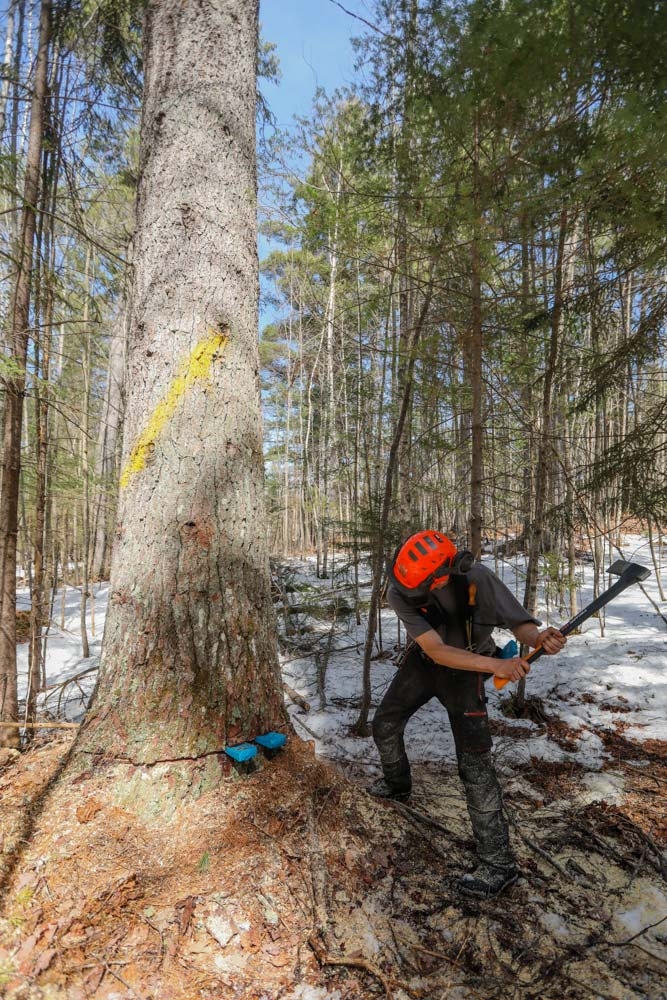
Trees are selected for removal with clear felling lanes in mind to avoid residual stand damage to trees left behind.
Limbing the tree. Note that the saw bar rests on the log during the limbing process. This helps to reduce fatigue for…
Limbing the tree. Note that the saw bar rests on the log during the limbing process. This helps to reduce fatigue for the operator and results in flush cuts that allow the log to skid smoothly, stack tightly on a log truck, and avoid hang-ups in the sawmill.
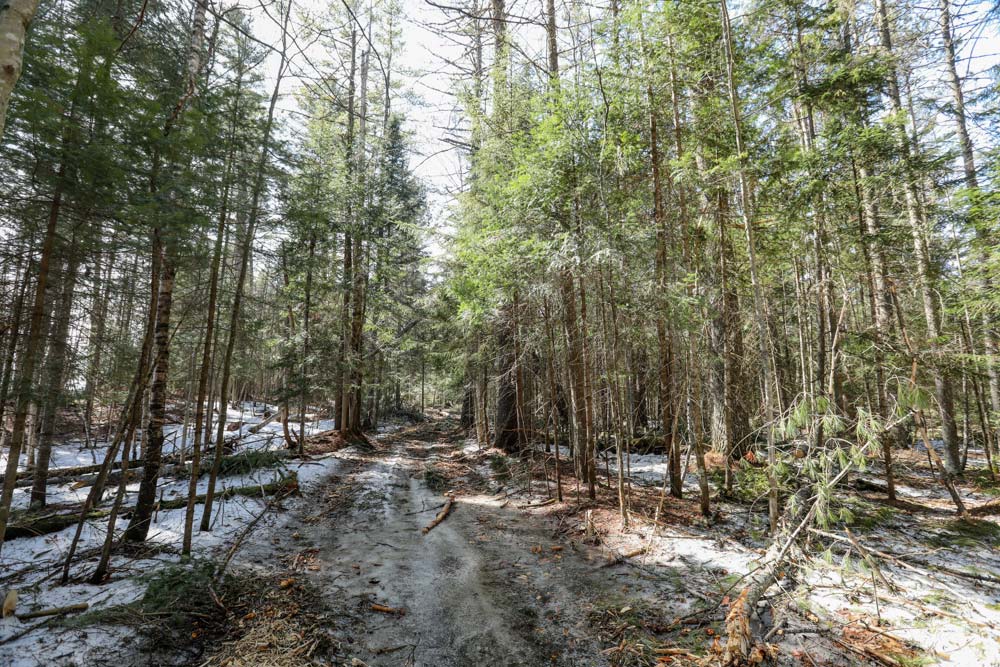
A frozen skid trail provides a durable, low friction surface for moving logs. Since the skid trail had been compacted…
A frozen skid trail provides a durable, low friction surface for moving logs. Since the skid trail had been compacted over the winter, the frost ran deep allowing this trail to remain frozen into early spring.
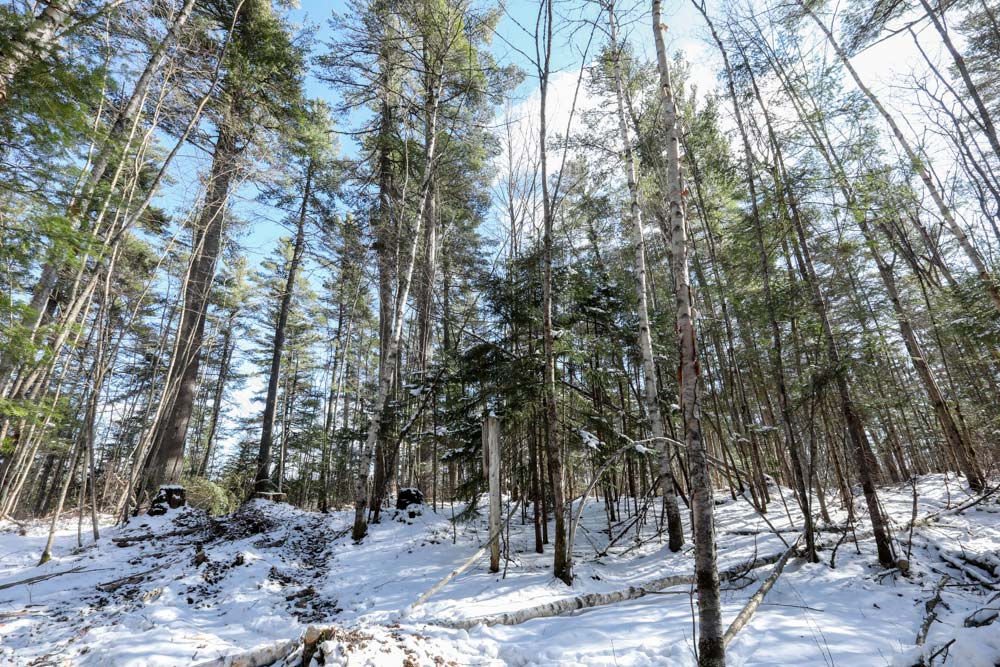
After thinning the remaining crop trees have less competition and more growing space which will increase heath and…
After thinning the remaining crop trees have less competition and more growing space which will increase heath and vigor of the stand.

No discussion as of yet.

Comments are closed on articles older than 90 days. We would still love to hear from you - email mail@northernwoodlands.org.