
Skip to navigation Skip to content

Felling Trees Against the Lean

Tricks_Illustrations.jpg
Illustration by Joseph Smith

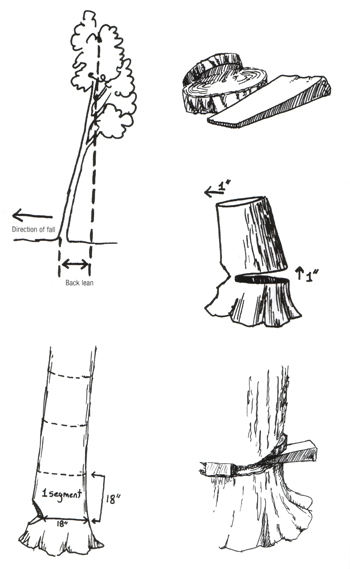
It is usually easiest to fell a tree in the direction that it’s leaning, but sometimes it’s necessary to fell it in the opposite direction. A tree leaning away from the intended direction of fall has “back lean.” By using wedges and shims to lift the trunk off the stump, you can compensate for the back lean and bring the tree up and over in the intended direction.

Once you have established the direction of fall, you can calculate the amount of back lean that must be overcome and the amount of lift necessary to do so through some simple calculations. While standing away from the tree, at a position 90 degrees to the direction of fall, sight up to the top of the tree using a weighted string or an axe as a plumb and note the location on the ground. The back lean is the distance from this point along the intended direction of fall to the apex of the planned undercut. The apex will be the front of the hinge and the pivot point for the falling stem. The weight of the tree must be brought over this pivot point before the tree will fall. In the 60-foot-tall tree at right, the back lean is three feet.

Next, figure the diameter of the stump by measuring from the front of the hinge to the back edge of the tree (see illustration). The stump diameter is used to determine the number of segments in the tree; one segment is a section of the tree with a height equal to the stump diameter. Thus, the 60-foot-tall tree with an 18-inch stump diameter has 40 segments (720 inches divided by 18 inches equals 40).

If you raise the back edge of the lowest segment one inch, you will move its front edge one inch forward. At the same time, the top of our 40-segment tree will move forward 40 inches, enough to overcome its 3-foot back lean. If the same tree had a back lean of 4 feet, it would require 1 ¼ inches of lift (48 inches divided by 40 sections = 1.2 inches) to overcome the lean. When calculating the lift, be sure to add in the 3/8-inch saw kerf, which means that one inch of lift will require 1 3/8 inches of wedge.

A combination of wedges and shims can be used to give you more lift. Cut discs of ½-inch to an inch in thickness from hardwood branches for the shims. Do not taper the discs, as that will make them weak and liable to break in the notch. Using two wedges, side by side, drive one home so that there is a gap between the stem and the top of the other wedge. Place a shim in the gap above the free wedge until it is snug, and then pound in the shim by driving the wedge. This should either fell the tree or free up the other wedge for a thicker shim. Repeat this process with increasingly larger shims until the tree comes up over the pivot point, and then gravity will take care of the rest.

Discussion *

Sep 27, 2021

I like your tree tips. I need an oak tree removed. I’ll have to hire a professional.

Tex Hooper
Apr 30, 2021

Thanks for the great info and feed back. I just recently started clearing my property of sketchy trees. I have 2.5 acres and am trying to extend driveway. Not to mention I have about 15 60’+ oaks 50’ from my home. Constantly thinking about them. Definitely getting the come along now. I’d rather not get crushed in the middle of the night by one. Thanks all.

Kyle
Jul 15, 2020

I have a very large old oak tree with a significant lean uphill at the back left corner of my cabin. It has many dead limbs in the top and it has significant insect damage showing at the base. There is a large hole showing at the base and I just can’t tell how much solid is left in the base of the tree. My neighbor has forbid me from felling it onto his property, which leave me only one direction to fell it and that is in the opposite direction of the lean downhill onto my property, or hire a company who can take it straight down piece by piece. Any suggestions?

Jack Perry
Oct 30, 2019

I’m going to be cutting a dead 80’ Silver Maple. It’s dropped several large limbs recently during windy weather and I’m afraid someone could get hurt or killed by a falling limb, it is on the property line so worried about neighbor also. I have decided to purchase a football helmet and shoulder pads thinking this will offer me more protection than a hard hat, as I’ve been researching this I’ve learned that often times dead limbs won’t follow the tree, they’ll break off and fall straight down. That scares me as that’s where I’ll be, and some of these limbs are quite large. There’s no way to get a bucket truck to the tree or I would hire a professional. Any expert advice would be appreciated. Thank you.

Jeff Jones
Feb 10, 2019

I have a 45’ tree that leans “almost ” correctly.  If I cut it the way it leans the top 15’ will hit the fence. I need it to land 3’ farther to the right . Should I make a partial back cut and put a wedge in the left side then finish the cut to make it fall to the right?

mickey miller
Dec 25, 2018

Trees bring us closer to God without the burden of religion and its guilt. Harvesting trees and wildlife is God’s way,  if done with respect and intelligence.Without both, nature can become deadly.

Alan Fligg
Dec 24, 2018

What you’re describing seems high risk to me.  You’re right that a tree that dead could snap, and it’s hard to say where it would snap.

Dave
Dec 20, 2018

I have a dead tree about 80’ tall and I’d say around 10” to 12” at the base. It goes up about 25’ then it starts bowing out about 6’ then back to the top leaning over my driveway. It’s not gonna hit anything except maybe another tree when it falls but I’d guess it’s so dead it will probably just break which also poses a problem but I’m sure I’ll be out of the way. It does look like it wants to fall where I want it to however this thing is Dead Dead Dead and I’ve never cut down a tree this dead. I’m afraid that when I start cutting it will just snap and I can’t find any good examples online to assist me with this. Any ideas of how I can do this safely and the risks I face attempting this would be helpful. If it does hit a tree it would be about 80% of the way up and it has no branches on it at all its so dead.

My2centz
Nov 18, 2018

Uncertain if backlean would work for me. High winds past several years have shifted lots of trees on the front face of windbreak. Most roots have been pulled out. Tree, roots and all…...no disease.

These trees are leaning on other small trees. About 15% angle.

Neighbor said just cut pulled-out roots. I don’t think that will work.

Would love to see illustration how to cut.

Much deep thanks!

Elise
Sep 28, 2018

Jane,

Many reasons.

1.  Wood burns and keeps our house warm.  It is a renewable power source that when replanted can resequester carbon.
2.  The tree is dead and at risk of falling on someone or something like my house.  I suppose I could wait for it to fall so you can help pay for my new roof through your insurance premiums, but I’m not that sleazy.
3.  The tree has partly fallen down but not completely with the same risks as number 2.
4.  To pretend we are Paul Bunyan.  It is fun to do.  Everyone should have the experience of felling a tree at least once in their life.  My girls will.
5.  Some trees are junk trees with little to no benefit for certain animal/plant habitats that are being encouraged.  Removing specific trees can help open the canopy.
6.  To remove invasive species.
7.  To clear land for improvements (house, driveway, garden, pool, etc.)
8.  To harvest trees for wood products/lumber.  Search for Alaskan Chainsaw Mill.  Anyone can do it.  Or hire someone with a portable mill.
9.  Because some people prefer the look of a manicured park to wild growth forest.
10.  Because not every tree provides shade or is adequate for hanging a swing.  Plus if I put up a swing on every tree I owned - it would be swing pollution.  (Hint I have 5 acres of trees.)

These were just 10 quick reasons off the top of my head.  Please actually think before you post.  I have never met anyone who doesn’t love trees.  But there are valid reasons to remove them just like there are valid reasons to use electricity from coal, nuclear, wind, and water power.  That is unless you want to live in the Stone Age without fire in a mud hut.  But then again, maybe you live somewhere warm year round.

But anything can be taken to an extreme or done wrong.  I’m just grateful there are sites like this to help keep people safe.

Joe Fake

Leave a reply

To ensure a respectful dialogue, please refrain from posting content that is unlawful, harassing, discriminatory, libelous, obscene, or inflammatory. Northern Woodlands assumes no responsibility or liability arising from forum postings and reserves the right to edit all postings. Thanks for joining the discussion.