

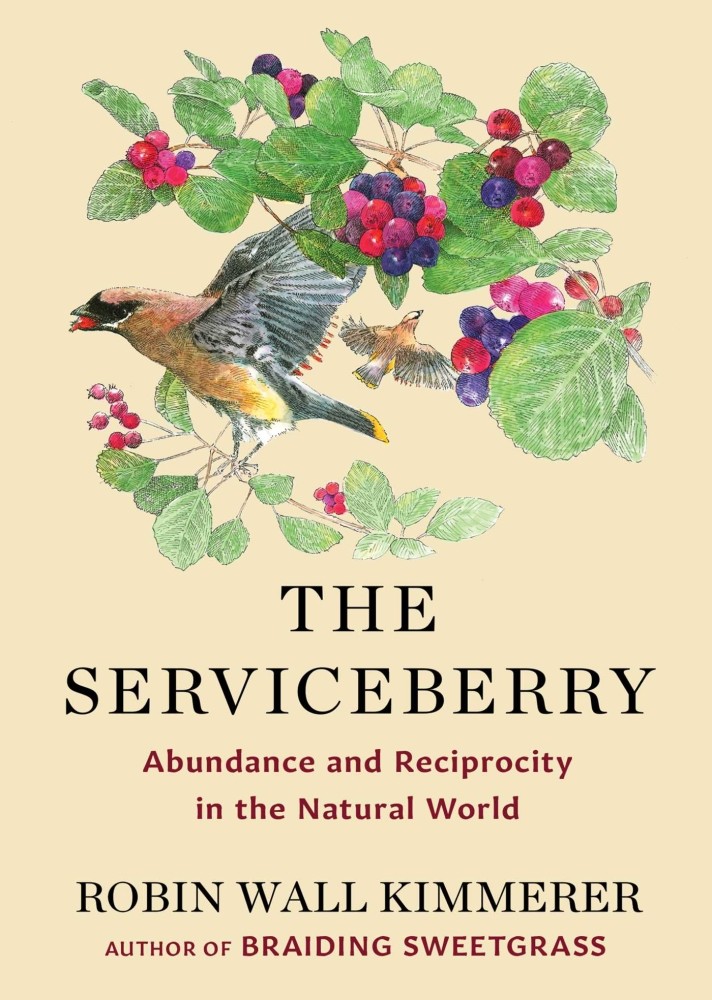
by Robin Wall Kimmerer
Scribner, 2024
Robin Wall Kimmerer’s The Serviceberry: Abundance and Reciprocity in the Natural World offers an appeal to readers to acknowledge the gifts they receive freely through nature and their communities, and to reciprocate that giving.
Kimmerer is a botanist, researcher, professor of biology at SUNY College of Environmental Science and Forestry, and member of the Citizen Potawatomi Nation. She shares a depth of knowledge of Indigenous stories as well as science to illuminate instances of the “gift economy” at play in nature.
The book begins with an invitation Kimmerer receives to pick serviceberries at her neighbor’s farm. The Potawatomi word for serviceberry, Bozakmin, ends with the root min, meaning “gift.” Kimmerer sees the shrub’s unconditional giving of fruit as a manifestation of the gift economy; there is no expectation of compensation.
Watching the birds feast on berries and reflecting on her own sustenance and joy from the harvest, she asks, “Isn’t this an economy? A system of distribution of goods and services that meet the needs of the community.” Throughout the book, Kimmerer interweaves conversations with economists and explanations of markets with Indigenous teachings, biology, and anecdotes from her own life. A recurring theme is that plants and animals don’t always choose competition in resource-strained environments and at times turn toward mutualism and cooperation instead.
Kimmerer uses a story about Brazilian hunter-gathers to show how humans participate in the gift economy, by choosing to turn away from the scarcity mindset and instead to share freely. In the tale, a hunter brings home a big kill and, instead of storing it for himself, invites his community to share in a feast. An anthropologist living with the group is perplexed, given the uncertainty of when the next kill might happen, and questions the hunter, who responds, “I store my meat in the belly of my brother.” Kimmerer returns to this line throughout the book, noting, “Wealth is having enough to share, and the practice for dealing with abundance is to give it away.”
Beyond the blend of Indigenous wisdom and science her earlier books have led readers to expect from her, Kimmerer reaches for the most accessible and immediate examples of the gift economy at work in modern society. She points out that Wikipedia and TikTok serve as open, collaborative platforms for sharing knowledge and that little free libraries provide avenues for free exchange. Including how these have the potential to be used to share and reciprocate makes Kimmerer’s vision feel less like a far-off dream and more like something we are already co-creating (albeit with less intention and awareness). Her enthusiasm and thoughtful writing make what could easily turn into a reprimand for overconsumption and self-centered thinking feel more like a warm hand guiding us back toward a philosophy of what Kimmerer calls “The Honorable Harvest” – an ethical relationship with the land that involves asking first, taking only what is needed, using it respectfully, sharing it with others in need, and giving thanks.
Kimmerer writes that reflecting on abundance and practicing gratitude allow people to be more accountable and happier. “To name the world as a gift,” she writes, “is to feel your membership in the web of reciprocity.” Originally a long essay published in Emergence Magazine, this slender volume is best read slowly and deliberately. It serves as a reminder that acting with community in mind – both human and at the broader ecosystem level – creates a sense of belonging and meaning. Like the taste of the serviceberries, Kimmerer’s words and lessons linger.