

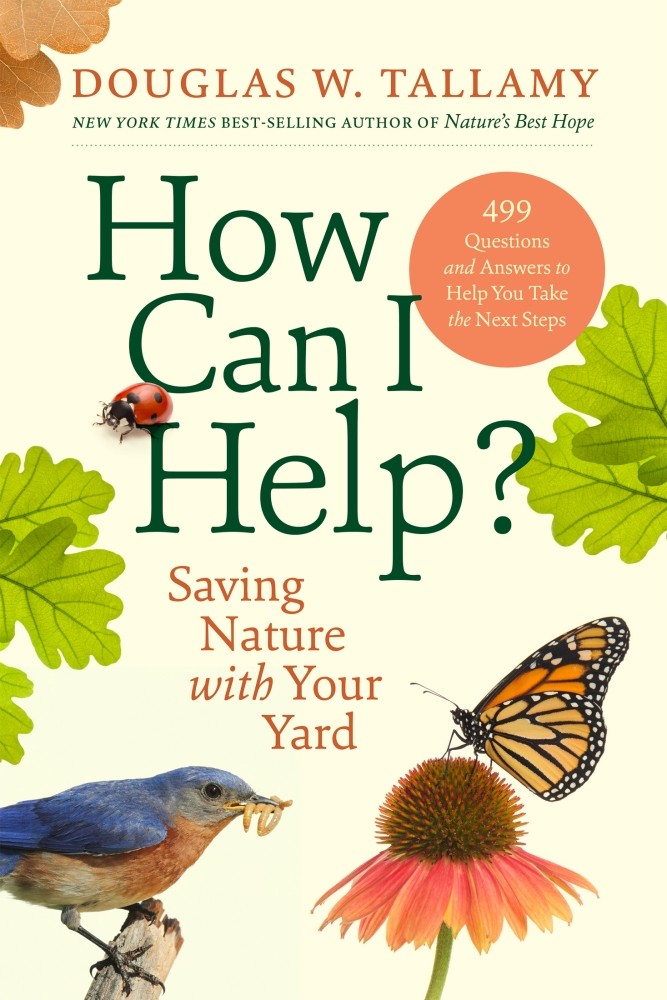
by Douglas W. Tallamy
Timber Press, 2025
Climate change and loss of biodiversity are not far-off crises. They are happening in our own backyards – quite literally – and there’s a lot we can do there to address these issues. That’s the thrust of ecologist Douglas W. Tallamy’s latest book, How Can I Help? Saving Nature with Your Yard.
With 135 million acres of residential landscapes in the United States, Tallamy sees “enormous conservation potential” in making homeowners more aware that how they manage their property is either making those problems worse or helping to correct them. Most residential properties were not designed with either biodiversity or climate change in mind; however, Tallamy shows that we can turn them into better functioning ecosystems that “support a diverse community of pollinators throughout the growing season, provide energy for the local food web, manage the watershed in which they lie, and remove carbon from the atmosphere where it is wreaking havoc on the Earth’s climate.”
This attractive volume contains a wealth of information, yet it is accessible and user-friendly. Tallamy’s lucid, relaxed writing style, his use of a question-and-answer format, and clearly organized chapters – on such topics as native and non-native plants, oaks, invasive species, pest control, and supporting wildlife at home – make it suitable to read in its entirety, by chapter, or as a reference. The detailed, 20-page index makes it easy to find specific information.
“We need to restore nature where we live, work, shop, and farm,” he writes, “because we need functioning ecosystems everywhere.” He asserts that sustainable stewardship and establishing a collaborative relationship with nature are everyone’s responsibility.
Tallamy emphasizes that native plants are essential for an ecosystem to thrive. Dynamic ecosystems, in which insects, plants, birds, and other wildlife effectively interact, take a long time to develop, and plant species within an ecosystem are not interchangeable. Non-native, ornamental plants may be attractive, but Tallamy compares them to statues that take space from native plants without contributing any value to the ecosystem. Sometimes, these plants become invasive, further crowding out the native plants needed to support and attract wildlife.
Just as the keystone at the center of a Roman arch keeps it from collapsing, keystone plants – those that support very high numbers of caterpillars and pollinators – are essential to maintaining healthy ecosystems. Tallamy recommends that, in addition to using regional plant guides to select plants, property owners consult the National Wildlife Federation’s online Native Plant Finder to make sure they include regional keystone species.
The book covers a wide variety of timely topics, from lawns (why we should reduce them) and No Mow May (which is not very effective) to insect control (usually best left to nature) and poison ivy (a good thing to have around!). Tallamy’s consistent message is to be knowledgeable and selective. For example, if you try to kill one insect species, you will probably unintentionally also kill others. Termites? Get rid of them, and he explains how to do it safely. Carpenter ants? They are harmless, Tallamy writes, and woodpeckers love them: “A Pileated Woodpecker is, in essence, nothing more than thousands of carpenter ants dressed up in pretty black-and-red feathers!” Butterflies may be prettier than moths, Tallamy writes, but moths are more abundant and, especially in the larval stage, are far more important in the food chain. Want to know more about monarchs? He writes seven pages about them, as well as six pages about mosquitos and nine about deer ticks.
How Can I Help? is essential for anyone who owns or manages property, and for many people, it would make an apt housewarming gift. I’m giving a copy to conservation-minded relatives who are building a house, as a gentle reminder that they aren’t getting just a house – they’re getting an ecosystem, too.