

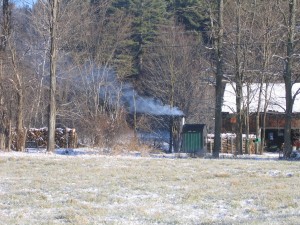
Tom Powers, a retired Air Force tech sergeant and a member of the Peru Town Council, keeps an eye on a wide range of issues that affect this northeastern New York town – zoning problems, the local water supply, road maintenance. Over the last couple of years, one of the top items on his agenda has been the plumes of smoke rising from a dozen backyard wood boilers in the town.
A couple of these wood boilers are right in the hamlet of Peru, about 750 homes lying along the banks of the Little Ausable River. The others are dotted around town, an 80-square-mile swatch of rolling woods, farms, and apple orchards about 10 miles south of Plattsburg. On a chilly, matte-gray day earlier this winter, all of them appeared to be in operation, smoke spiraling lazily into the lowering clouds.
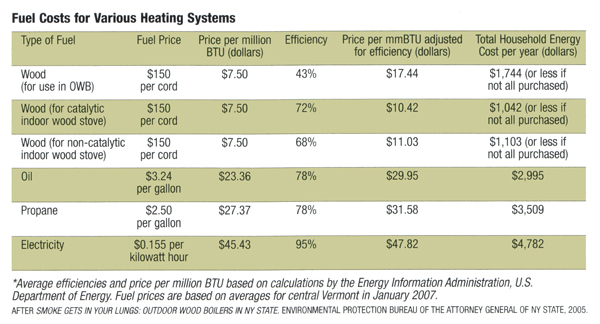
These outdoor boilers burn wood – and almost anything else – and typically supply heat to one or more buildings at far less cost than it takes to heat a house or barn or greenhouse with fuel oil or propane, a disparity that grows as the cost of oil goes up.
The smoke, however, is a very serious problem. Most outdoor wood boilers are primitive from an engineering perspective – simply metal boxes surrounded by a small water jacket. The wood burns in the box and heats the water, which is circulated to the building. If it’s inconvenient for the owner to tend the boiler, he or she can load it with fuel every 12 to 24 hours or so and adjust the thermostat so it will deliver a steady trickle of heat all day.
Burned in this fashion, the fire simply smolders for much of its burn cycle, sending smoke wafting out of the stack. The stacks are usually quite short, roughly half the height of the roofline of a two-story house, which means that the smoke can form a pall near the ground. If there are nearby neighbors, their homes can be invaded by the smoke. The problem is exacerbated when operators burn green or wet wood, or, worse still, things like garbage or old tires, which some of them do.
At the same time, outdoor boilers potentially are a very cost-effective way to utilize firewood, of which there is an enormous supply, especially in the heavily forested areas of the northern tier of the United States. Furthermore, burning wood for fuel is sustainable because wood, unlike coal or oil, is a renewable resource. Replacing those fuels with wood reduces the user’s “carbon footprint” and thereby decreases global warming. And these boilers can be made to burn cleanly. Some producers have developed boilers with drastically reduced emissions and increased burning efficiencies. These cost more to install, but savings from more efficient use of fuel help earn back the initial investment.
These factors – the threat from low-lying wood smoke, the prospect of big financial savings, and potential environmental benefits – have combined to form a highly contentious public issue. Some states, including Vermont and Maine and, farther west, Michigan and Washington, have established strict constraints on boiler emissions. New York is now developing a statewide regulation. Meanwhile, many town governments, particularly in New York and Massachusetts, have moved on their own to regulate outdoor boilers.
In response, the wood-boiler industry has mounted an aggressive campaign to protect its right to continue to produce boilers of all types, including the poorly engineered, smokier units.
Heating with Wood
For a process whose roots lie well back into prehistory, burning wood to generate heat can be surprisingly complex. In this country, we began with fireplaces, where much of the heat went straight up the chimney, and then we moved to various types of indoor stoves. The generation of woodstoves that appeared in the mid-1960s was not a whole lot more efficient than fireplaces. The fact that they could be damped down – deprived of a full supply of air – meant that a homeowner could load them up, choke off the air flow, and then get a more or less steady flow of heat for hours.
Choking off the air supply, however, is an inefficient way to get heat out of fuel and also a very dirty one: these stoves were generating a lot of smoke and pollution, and that was a major problem. In a town like Waterbury, Vermont, which lies in a bowl of hills along the Winooski River, a temperature inversion in winter could trap the smoke near ground level and make the town almost uninhabitable.
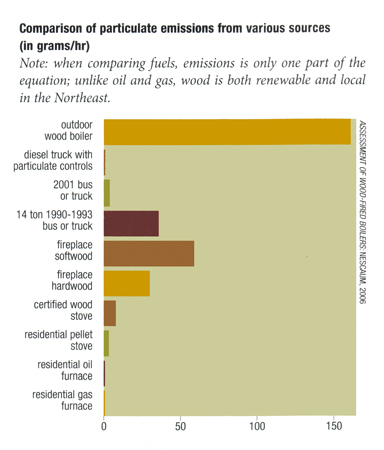
In response to the public outcry over this issue, the federal Environmental Protection Agency (EPA) issued rules in 1988 that forced manufacturers of wood stoves to improve their products. The older stoves, pre-EPA-certification, would typically emit 40 to 60 grams of fine particulates into the air every hour. After manufacturers were required to meet EPA standards, the allowable limit was set first at 8.5 grams per hour; in 1990, that limit was cut to 7.5 grams per hour (4.1 grams for catalytic stoves). So, to stay in business, manufacturers completely re-engineered woodstoves with catalytic converters or improved air flow to burn wood efficiently and cleanly.
These regulations, however, exempted wood-fired central heating appliances, including outdoor wood boilers. When manufacturers recently began to ramp up production of these devices, many of them used the same old inefficient box technology of the banned indoor woodstoves, which is simpler and less expensive to make – and just as smoky as the banned woodstoves.
Even the cleanest-burning woodstove emits some pollutants, which can include soot, fly ash, creosote, and heavy metals. These chemicals can be very dangerous in and of themselves, but perhaps the greatest danger from wood smoke is that the particles produced can be very small, smaller than 2.5 microns. A micron is a millionth of a meter, and 2.5 microns is roughly one-20th the diameter of a human hair. When a person breathes in these tiny particles, they go deep into the lungs, bypassing the normal protective structures of the airway that capture bigger particles. Any particles less than one micron in size not only enter the deepest part of the lungs but also go directly into the bloodstream. A growing body of medical research shows that these particles are carcinogenic and dangerous to human health.
Proven Technology
It doesn’t have to be this way. There are outdoor boilers on the market that can burn wood with negligible emissions and minimal danger to public health, producing smoke that is even cleaner than that of the newer, EPA-certified indoor woodstoves. One of these is the Garn boiler, produced by the Dectra Corporation of St. Anthony, Minnesota. The Garn, which when standing out in the open resembles a miniature railroad tank car, is built of heavy steel and is well insulated. The main combustion chamber is a rather small box that sits inside of a large pool of water, which acts as a heat sink.
Air is sucked into the unit by a constantly turning fan and is divided into two streams before it enters an insulated combustion chamber. The bottom stream goes right through the burning logs and engenders a very hot fire. The second stream passes over the top of the combustion chamber and gathers the volatile gases being given off by the burning logs. That stream enters a secondary combustion chamber, where these gases are themselves burned. The exhaust that remains, much of it water vapor, then traverses a serpentine exhaust system running through the water pool, which wrings even more heat out of it.
This type of wood-gasification boiler solves the emissions problem by addressing the fundamental physics of the issue, namely that the burning of wood and the storage of heat need to be handled in two separate stages. In order for wood to be burned efficiently, it needs a well-insulated firebox with lots of airflow to achieve high temperature combustion. In order for the resulting heat to be utilized effectively, it requires a large storage reservoir that can hold the heat between firings. Rather than smoldering away, therefore, a Garn is burned hotter (and less frequently) than the low-tech smoky boilers, whose design places a small reservoir of cold water directly against the firebox.
For comparison, the water reservoir in Garn boilers range from 1,400 to 3,200 gallons, depending on the model. Those in the smoky variety range from 140 to 400 gallons. The efficiency ratings of the two types of boilers bear out the Garn approach. According to New York State’s Department of Environmental Conservation, the efficiency of the older outdoor wood boilers currently operating in the state ranges from 28 to 50 percent, with an average of 43 percent. That means that for every two logs you put on the fire, the heat from at least one full log goes up the chimney. EPA-certified woodstoves, by contrast, run from 68 to 72 percent, obviously much better. The efficiency of the Garn outdoor boiler, meanwhile, exceeds the EPA standard for woodstoves.
The rub, of course, is the price. According to Eric Johnson, editor of The Northern Logger magazine and moderator of an online discussion forum on wood-fired boilers, wood gasifiers range in price from less than $5,000 at the low end to more than $10,000 for a Garn. “Bear in mind that there are substantial installation costs for these boilers as well as the relatively high initial purchase price,” Johnson said. “You have to take into account things like piping, a chimney or chimney liner, optional hot water storage, heat exchangers and other equipment and parts needed to mate a wood gasifier to your existing home heating system.” Johnson added that the hot water storage is already included in the Garn design.
Setting Standards
Since the 1970s, the air quality divisions of the six New England states plus New York and New Jersey have been working together as a group on solutions to emission problems. This group, called NESCAUM (Northeast States for Coordinated Air Use Management) has turned its attention to wood boilers and has produced a model rule that it recommends to any government body trying to regulate outdoor boilers.
In essence, the rule aims at making the boilers approximately as clean-burning as EPA-approved indoor woodstoves. The devices are not entirely comparable, however, and NESCAUM and others interested in the outdoor wood boiler industry have developed a different set of measurement standards: indoor woodstove emissions are measured in grams of fine particulate per hour, while outdoor boilers are assessed in terms of pounds of particulates per one million BTU (British Thermal Units) of heat produced inside the boiler.
The NESCAUM emission standard was set at 0.44 pounds of particulates per one million BTUs produced in the boiler (not delivered to the house). The EPA has set a guideline (unlike a standard, a guideline is not enforceable) for outdoor boilers of 0.60 pounds per million BTUs. Most regulations now in effect or being adopted in the region use one or the other of these two numbers. By 2010, the NESCAUM model also calls for an even tighter standard to be adopted: 0.32 pounds per million BTUs.
These emission level provisions are central to the issue, and controversial, because once adopted by a state, they would force a manufacturer of traditional smoky boilers to either redesign its units or retreat from the field.
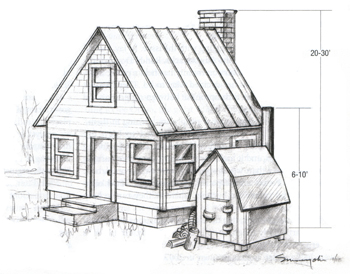
Other provisions that NESCAUM recommends include standards for setbacks from roads and neighbors, guidelines for opacity of smoke (another indicator of how cleanly a boiler is operating), and minimum smokestack heights to protect against particulate emission. Low smokestack heights have been a particularly vexing issue since, unlike indoor woodstoves, whose chimneys are required to be taller than the surrounding roof and whose tops are generally 20 to 30 feet above the ground, the typical outdoor boiler comes with a stack more in the 10- to 12-foot-high range.
As important as these NESCAUM constraints are, an equally important provision of the model rule is that it applies to manufacturers, not to the individuals who buy and operate the boilers. Just as with woodstoves, no one expects some government employee to go around checking on the volume of smoke coming out of a backyard stack. The rule envisions that governments will set up certification systems that manufacturers will have to comply with in order to sell their units in that jurisdiction.
A rule incorporating much of the NESCAUM model goes into effect in Vermont on March 31, 2008. The emission standard will be 0.44 pounds of particulates per million BTUs and will improve to 0.32 pounds in 2010. Maine’s law goes into effect at the same time, but using the EPA’s emission standard of 0.60 pounds rather than 0.44. Maine will, however, also go to 0.32 pounds in the spring of 2010. Both states have setback and stack height provisions.
Many towns in other states in the Northeast, meanwhile, are imposing restrictions of their own; these vary widely in detail and effectiveness. At least 20 towns in Massachusetts have instituted at least some controls. Several towns in the eastern Adirondacks are among the more than 50 communities in New York that have either done so or are considering it. In early January 2008, for example, the town of Essex, New York, adopted a rigorous, multi-pronged law for their community.
Ron Jackson, the town administrator in Essex, said that the issue had been very contentious but after several public discussions, there was a strong consensus that something had to be done. The final ordinance was one of the strictest adopted by a single community.
Out in the countryside, any new boiler will have to meet the 0.44 pound per million BTU standard. This will eliminate many of the units currently on the market. The operator will have to burn seasoned wood, or other high-quality fuel such as corn, wheat, soybeans, or wood pellets. In the historic district, a hamlet surrounding the ferry dock on Lake Champlain, the boilers are banned entirely; the reason, Jackson says, is that the houses are very close together and at a low elevation, so temperature inversions cause smoke to sit down among the houses.
In the rest of the hamlet and running along the shoreline north and south of the ferry dock, there are setback requirements. Any neighbor within 500 feet of a proposed boiler would have to agree in writing not to object. Finally, in this district – between the open farmland and the historic district, mostly right along the lake shore – boiler operation would be banned from May to September.
Other towns are still struggling with the issue. In Jay, a small town in the high peaks of the Adirondacks, Randy Douglas, the town administrator, said his community has held a public hearing on the issue but has not decided what to do. They have set up a committee to seek a compromise between supporters and opponents of regulation.
“One of the problems is what people are burning in them,” Douglas said of the boilers. “You’re supposed to burn dry wood…I’ve seen with my own eyes the black smoke rolling right out of them, and it leads me to believe they were burning something other than wood – construction debris or garbage or whatever. People are desperate,” he continued. “Fuel oil is expensive, and people are burning whatever they can to keep their stoves going.”
The fact is, however, that developing regulations at the local level is particularly tough, socially and politically. Tom Powers in Peru, New York, is acutely conscious of that every day. There were half a dozen boilers in town in 2007 when Peru enacted a moratorium on outdoor boilers and set up a committee to work on it.
“I don’t believe the town wants to ban them,” he said. “I wouldn’t want to see them in the hamlet, but if they were in the back woods, it wouldn’t matter.”
The members of the Town Council know all the residents who operate the boilers in town, including within the hamlet. In a small town, it’s hard to say no to your friends and neighbors. That’s true even though Peru is unusual in having a local law on the books requiring any Peru resident to get a town permit before installing any heating device, even in the house. Of the dozen boilers now in town, only one has such a permit. Will the Town Council move against these illegal boilers? Powers just doesn’t know.
The Battle Heats Up
Estimates of the number of boilers operating nationwide run from 150,000 to 200,000, with very rapid growth. There are dozens of manufacturers, many of whom are represented by a national trade association, the Hearth, Patio and Barbeque Association, which has mounted an all-out defense of their members’ right to continue to produce and sell even the smokiest boilers. Advocates for regulation, they charge, are simply trying to stop people from heating with wood.
The largest of the U.S. manufacturers is Central Boiler, Inc., of Greenbush, Minnesota. Rick Kezar, sales and marketing director for Central, declined to disclose the emission figures for the company’s Classic boilers, one of the most popular units on the market, but he denied flatly that they were a problem. He also acknowledged, however, that the Central Classic boilers could not meet the 2008 Vermont or Maine emission standards.
Advocates for regulation are betting that the tightened standards will lead to very sharp upgrades in technology and that air quality will benefit from that. In fact, Dick Valentinetti, the director of the Air Pollution Control Division of Vermont’s Department of Environmental Conservation, notes that Central Boiler has designed a boiler that would qualify for certification under the new Vermont law. At the time this story went to press, however, there was some question of whether Central Boiler’s “E-Classics” were yet available for purchase.
Valentinetti said that he did not think that there would be any governmental moves to eliminate old smokers that are already in place. Instead, they would be grandfathered in. Adam Sherman, an analyst at the Biomass Energy Resource Center (BERC) in Montpelier, Vermont, says he worries about manufacturers dumping as many of their early boilers on consumers as possible before the regulations take effect.
Phil Etter, environmental analyst for the Vermont Air Pollution Control Division, said that there are a number of technical issues surrounding testing of the emissions and efficiency of outdoor wood boilers, but that these are on their way to resolution. Once those are resolved, he says, there will be no problem delineating high-quality boilers, with advanced technology, from the old-style smokers.
Community Boiler
One of the most striking demonstrations that it’s possible to generate heat sustainably and cleanly with an outdoor wood boiler can be found at a place called Cobb Hill in Hartland, Vermont, a 270-acre farm lying in a bowl of hills a few miles west of the Connecticut River. Cobb Hill is a co-housing project, comprised of about 20 families, with 40 or so adults and 20 children. On the valley floor, the residents operate a farm that produces vegetables, turkeys, meat chickens, honey, maple syrup, and a herd of Jersey cows that supports a thriving cheese business. Also on the site is the Sustainability Institute, which does research on systems issues.
The residents live in a necklace of homes that climb a steep rib of Cobb Hill northwest of the valley floor. The organization and ethos that guide the group reflects the vision of the late Donella Meadows, a systems analyst at Dartmouth College, who was one of the project’s co-founders.
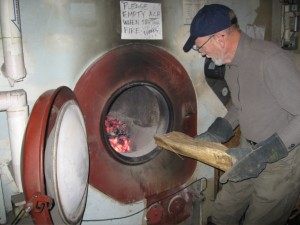
About halfway up the hill, roughly in the middle of the housing units, both duplexes and single-family homes, is a low building that houses a Garn outdoor wood boiler and 60 cords of firewood. This boiler provides 85 percent of the annual heat and hot water needs for 19 single-family homes, three apartments, and a common house for the community. The remaining heat is supplied by propane. A back-of-the envelope calculation shows the annual cost to be around $400 per family. By contrast, the Federal Energy Information agency estimates that the typical per-family heating cost in the Northeast in the winter of 2008 will exceed $2,000. One-fifth of the cost, and of course, the Garn produces minimal emissions.
The Cobb Hill boiler does exact a social cost that couldn’t be met by the ordinary residential boiler operator. The co-housing group assigns a resident to monitor the maintenance needs of the machine, checking things like its gaskets and other mechanical parts, and watching the fuel use. The current monitor is a retired physician, Alan Keitt; he is backed up by his predecessor, Phil Rice, an analyst at the Sustainability Institute.
In very cold weather, the Cobb Hill residents add fuel to the boiler every hour for 19 of the 24 hours in the day, which is part of the shared responsibilities. Loading the boiler, however, is very simple. Open the door, throw two or three chunks of 30-inch-long firewood onto the bed of coals, close the door, and you’re done. And the one boiler is heating 23 family units.
“We could have gotten a pellet boiler (with automatic feed),” Rice said. “But chunk wood is local and it has much less embodied energy than wood pellets. You have to pay attention to what you’re doing,” he continued. “If you just want to turn on a thermostat, don’t heat with wood. When you handle the wood that heats your house, it closes a cycle in your mind. People who move here from the city now appreciate how the whole heating system works. I think that’s critical.”
Rice said that getting the five-A.M. shift enriches his life. “It’s my time to see Orion, the great winter constellation. I see it at night when it’s coming up, and then, at 5 A.M. I see it going down. I get to see some glorious things.”
Whether the outdoor wood-boiler industry itself will see similarly glorious things remains an open question. The next few years will see more and more states and towns adopting regulations, while manufacturers will come out with new models to try to meet those regulations. Outdoor wood boilers may yet become the right answer to how best to heat a house in the Northeast – a region where those houses are surrounded by the fuel that heats them.
Discussion *