

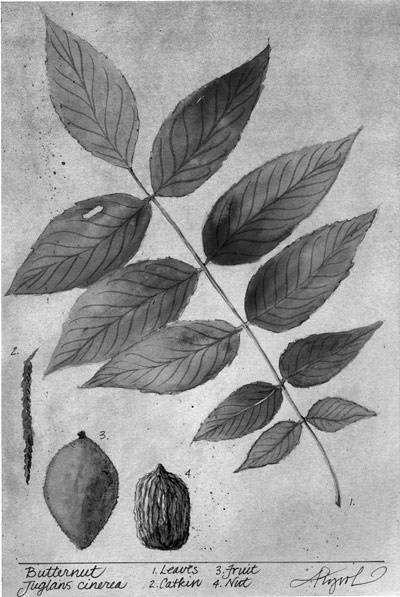
Butternut country is so distinctive that Parker Nichols knows he has arrived even before he sees the first butternut tree. As the proprietor of Vermont WildWoods, a flooring and millwork company in Marshfield that specializes in salvaging diseased butternut trees, he’s seen much of Vermont’s butternut country.
As he turns off the paved road onto a dirt road, and then onto an even smaller dirt road to the log-landing, he often finds himself surrounded by big maple trees, ashes and basswoods. Then, he’ll spot it—the first butternut tree – on a hillside, a favorite spot for butternut. The trees also like light, so they grow in clearings caused by fire, logging or heavy winds. And they like limey soil. Nichols notes that ginseng and wild ginger, two other lime-loving plants, often are found near butternuts.
Nichols is on a mission. Butternut trees are being threatened with disease, and he wants to help save them. His company will pay good money for an ailing tree—but only on the condition that any healthy butternut trees in the stand are left alone. A butternut stricken by butternut canker, a fungus, is scarred with football-shaped wounds, which sometimes ooze. The tree fights back by growing over the wound, but the fungus usually wins. The tree dies when its trunk has so many fungus-caused wounds that the trunk is girdled, and no nutrients can pass back and forth between leaves and roots.
Butternut canker was first identified in Wisconsin in 1967. Nobody knows its original source; but because it is so good at killing butternut trees, it’s generally thought to have been introduced to North America. The theory is that if the disease were endemic butternuts would have developed resistance to it long ago.
“Butternut is declining rapidly,” says Dale Bergdahl, a retired University of Vermont forestry professor, who has been studying butternut canker and is considered a leading expert on the disease. “In Vermont, we are at 60 percent mortality now. In Maine and New Hampshire, they were at 30 percent mortality as of last year.”
The trend has been consistent and dire. “A restoration effort is our only hope” for the species’ survival, Bergdahl says.
Bergdahl’s work with butternuts is in two major areas: researching how the fungus is spread, and locating healthy butternuts trees that can be used in future restoration efforts.
The fungus is spread when falling rain splashes the fungus spores from one tree to another, Bergdahl says. But fungus spores can travel far and fast on the bodies of insects, a pattern especially obvious in New Hampshire, where diseased stands are sometimes miles apart. Bergdahl has found sticky fungus spores, sometimes millions of them, on 17 species of insects capable of flying from tree to tree.
Bergdahl is currently working for the U.S. Forest Service to locate butternut trees in the Northeast that appear to be disease-resistant. Eventually, cuttings and nuts will be taken from these trees to create nurseries of resistant trees.
In New Hampshire, Kyle Lombard, a forest entomologist with the Division of Forests and Lands, oversees the state’s efforts to propagate butternut “super
trees,” that show no signs of the disease despite growing near trees that have it. Both Lombard and Bergdahl want to hear from private landowners about the location of healthy butternut trees. Bergdahl (.(JavaScript must be enabled to view this email address)) will assess such trees for possible use in restoration efforts.
Bergdahl is especially interested in locating groups of 10 to 15 trees in the same general area. Ideally, some of the trees will have the butternut canker, and others will be healthy.
Nichols looks for the same thing: mixed stands of healthy and diseased trees. “For my own business, I need the dead ones,” he says. Through Vermont WildWoods these diseased trees are turned into architectural design elements – from beams in a steakhouse in Atlantic City to flooring in an upscale clothing store in California.
“It’s sad that these trees are dying,” says Nichols, but he believes his business is helping the remaining butternuts survive by alerting loggers to the trees’ plight and giving them incentives not to cut the healthy ones.
Discussion *