

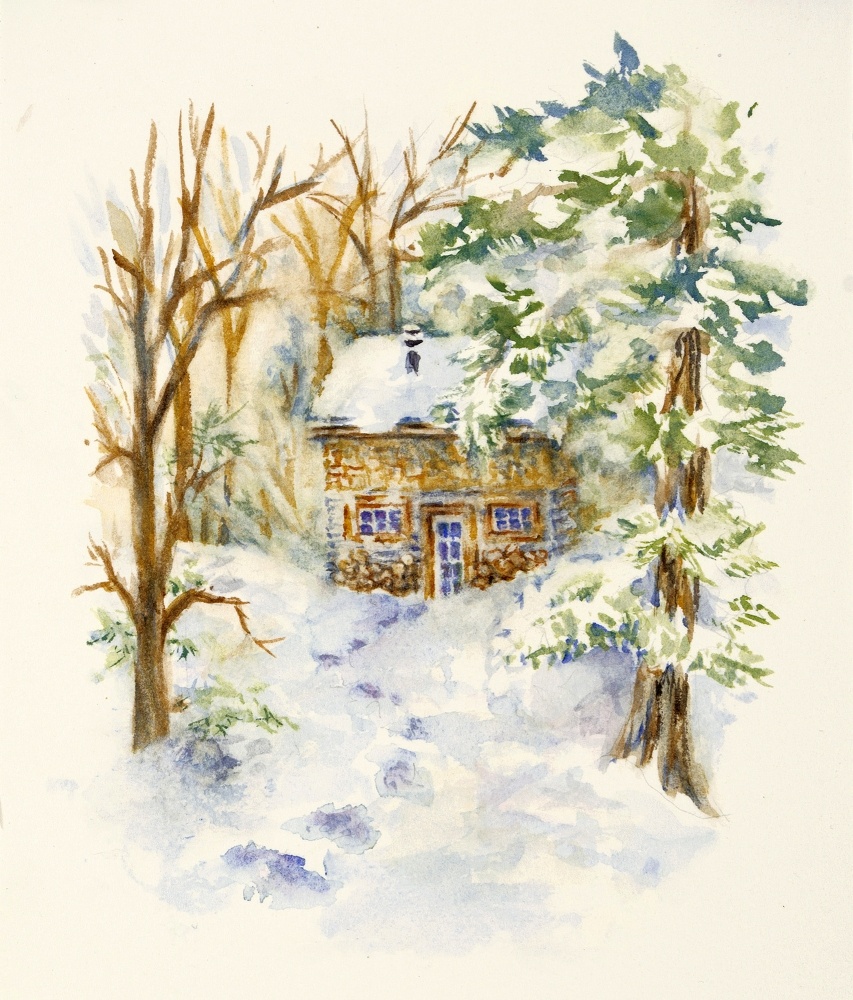
Winter drapes the hills around the cabin in white, softening the world and quieting its noise. The stillness of the season settles around us, inviting us to live each day with intention, guided by tradition. Each storm slows our steps, deepens our listening, and I realize that we do not merely endure winter, but lean in to it. The faint sound of snow falling from the trees is like a companion, patiently teaching us that life has a rhythm far greater than our own.
From grief and determination, my partner built this small cabin beneath the towering hemlocks. Every stone he placed in the foundation, every beam set with intention, was an act of devotion. Labor and patience became inseparable, creation and healing one and the same. Building this cabin was a meditation in stone and wood, a form of repair, as my partner pieced himself together.
I am in awe at the way it comes to life, the hand tools leaving their notes of labor on each rough-hewn beam. Every corner, every joint, every detail radiates a richness and soul that standard houses can never capture.
Inside, the cabin wraps me in a sense of home that feels both immediate and timeless. The deep scent of pine greets me as I enter, the air steeped in warmth. Sunlight streams through the windowpanes, catching dust motes and painting the walls in gold. The old wood cookstove – Herald, as we call it – anchors the room. I kneel before it, as if offering a small sacrifice of wood, coaxing embers into flame, feeding the stove with logs we split under the summer sun. Each one carries a memory of effort, sweat, hours beneath the sky, the weight of the forest itself. Even the labor of hauling wood becomes a ritual of presence. Here, I begin to see the world differently, as if these acts carry a meaning I have mostly overlooked in my life.
Here, I see the rhythms more clearly. Spring arrives in thawing brooks, summer in the pressing demands of work, autumn in the urgent reds and golds. And then winter – stripping life down to the essentials: a warm fire, a good meal, and rest. Standing outside with snowflakes melting on my skin, I feel myself learning a new attentiveness in a way I never could in the noise of modern life.
On nights when the wind rattles the windowpanes, the cabin glows like a lantern as we carry in wood. Beeswax candles cast shadows across pine boards. Herald sighs and crackles. My partner and I sit at the table together for a game of chess by candlelight, no distractions, no digital dings, only the hush of the forest, the hum of the stove, broken now and then by a branch tapping the window or the call of an owl. In these moments, I find that life is measured not in quantity but in depth.
History lives in these hills. Families once raised children by lamplight, warmed cabins with wood, lived lives dictated by necessity. My partner has made a deliberate choice, a conscious return to a life rooted in tradition. I feel the weight of that choice, the courage it takes, and I, too, now carry that courage.
On mornings when snow falls heavy, I watch him step into the cold air, one with the small movements of the forest, chickadees flicking between branches, deer tracks pressed into snow, the brook chattering beneath ice. Winter is not barren but rich. I feel these parts of the season with him, and it changes the way I move through my own world.
Back inside, he feeds Herald as the pale light stretches across the floorboards. The cabin teaches me that stillness is not absence but presence, and peace is not found in accumulation but in paring back. Through my partner’s labor and attentiveness, I learn that winter is not something to survive, but something to savor. If I listen closely – to the fire, to the forest, to the soft rhythm of his heartbeat – I hear what he has found, what perhaps those who lived in these woods before him always knew: in simplicity, there is more than enough.